Why After Strait of Hormuz Bypass 2026 Announcement Oil Prices Are Falling Fast
Oil prices are falling fast, and the reason goes far beyond normal market fluctuations. Fresh hopes of easing Middle East tensions, improving tanker movement, and new Strait of Hormuz bypass infrastructure are changing the global energy landscape. Investors, traders, and consumers are now closely watching whether this could trigger a longer-term drop in fuel prices worldwide.
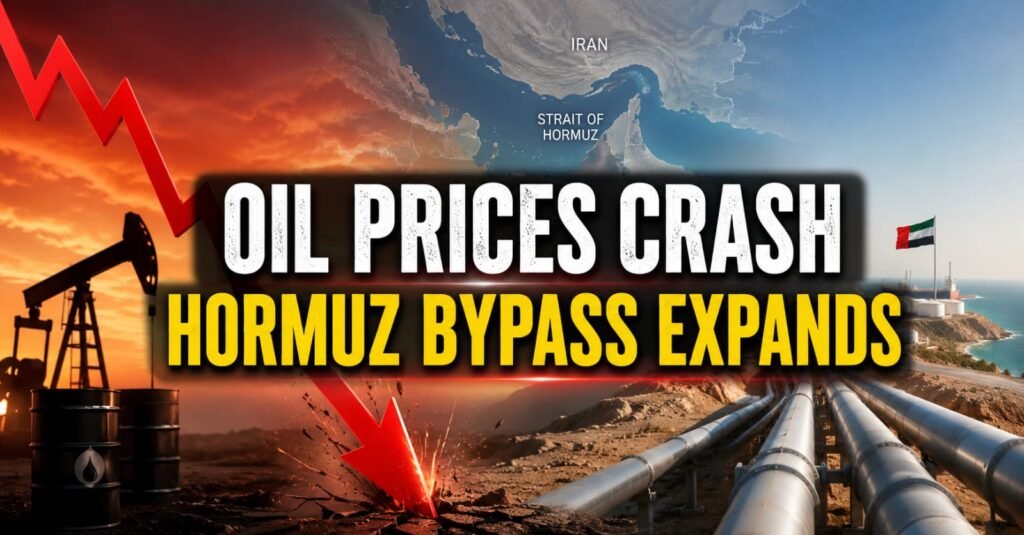
Oil Prices Fall as Strait of Hormuz Bypass Hopes Grow
Oil prices are declining primarily because geopolitical tensions are easing. Hopes of a negotiated peace deal with Iran are raising expectations that supply blockades in the Middle East will be resolved and global shipping will normalize.
The sharp drop is driven by the following factors:
Easing of Geopolitical Risk
Reports suggest Washington and Tehran are progressing toward an agreement. This has prompted traders to remove a significant portion of the “war-risk premium” from oil futures.
Resumed Shipping Flows Through the Strait of Hormuz
Hopes are growing for the removal of disruptions in the Strait of Hormuz — a crucial oil shipping route — after satellite and transit data indicated an increase in supertanker traffic.
Sustained Global Supply
Despite OPEC+ production cuts, global supply has remained resilient, with U.S. shale production continuing at near-record levels.
Demand Concerns Continue
Ongoing worries about a broader economic slowdown in major energy-consuming nations, such as the U.S. and China, continue to weigh on the overall demand outlook.
Why the Strait of Hormuz Bypass Matters
Bypassing the Strait of Hormuz relies on massive land-based crude oil pipelines that transport oil from Persian Gulf producers to terminals on the open ocean. With the Strait serving as a critical global chokepoint, these pipelines act as vital “war insurance” for maintaining energy exports during regional blockades.
Even a temporary disruption in the Strait of Hormuz can shake global oil markets, making bypass infrastructure increasingly important for long-term energy security.
Operational Strait of Hormuz Bypass Pipelines
UAE’s Habshan-Fujairah Pipeline (ADCOP)
Also known as ADCOP, this 380-kilometer pipeline stretches from Abu Dhabi to the port of Fujairah on the Gulf of Oman. It currently possesses a capacity to move roughly 1.5 to 1.8 million barrels per day (bpd), significantly reducing the UAE’s sole reliance on the Strait of Hormuz.
Saudi Arabia’s East-West Pipeline
The Petroline system crosses the Arabian Peninsula, connecting oil fields in the east to the port of Yanbu on the Red Sea. It is designed to carry up to 5 to 7 million bpd, allowing a large portion of Saudi crude to exit without entering the Persian Gulf.
UAE Accelerates New Strait of Hormuz Bypass Project
The UAE is constructing a new oil pipeline that serves as a major Strait of Hormuz bypass. Known as the West-East Pipeline, it is currently 50% complete and is on track to become fully operational by 2027.
The pipeline is designed to significantly reduce the country’s dependence on the strategic maritime chokepoint amid escalating regional tensions.
Key Details of the New Pipeline
The route will transport crude oil from Habshan in Abu Dhabi directly to the port of Fujairah on the Gulf of Oman, bypassing the Strait of Hormuz entirely.
The project aims to double ADNOC’s export capacity through Fujairah.
The UAE already operates the existing Habshan-Fujairah pipeline capable of moving roughly 1.5 to 1.8 million barrels of crude per day. The new pipeline will further expand this capacity.
Capacity Limitations Still Remain
Despite these massive infrastructural projects, alternative routes cannot fully replace the Strait of Hormuz. Pipelines currently cover only a fraction of the total oil volume that normally transits the waterway, leaving global markets highly vulnerable whenever passage through the Gulf is hindered.
Analysts believe that while the Strait of Hormuz bypass projects reduce risk, they cannot completely eliminate the global economy’s dependence on one of the world’s most critical energy chokepoints.
The recent oil price decline highlights how quickly geopolitical developments can reshape global energy markets. While growing Strait of Hormuz bypass infrastructure offers some protection against future disruptions, the region remains a key pressure point for the world economy.
For more global energy updates, oil market analysis, and breaking infrastructure news, keep visiting our site daily.
Disclaimer: This article is published for informational purposes only. Readers are advised to verify details from official sources before making any decisions. The website is not responsible for any loss or damage arising from the use of this information.