The Alarming Construction Quality Crisis 2026: San Francisco’s Sinking Tower and India’s Collapsing Roads Exposed
What happens when speed beats safety in construction? From a luxury skyscraper silently sinking into San Francisco’s soil to brand-new expressways crumbling before the monsoon even begins — the global construction quality crisis is no longer a silent warning. It’s a loud, expensive, and dangerous reality. Unlike countries such as China, where strict action is often taken against poor construction, India and even the U.S. are still struggling to hold builders accountable. This affects every commuter, homeowner, and taxpayer.
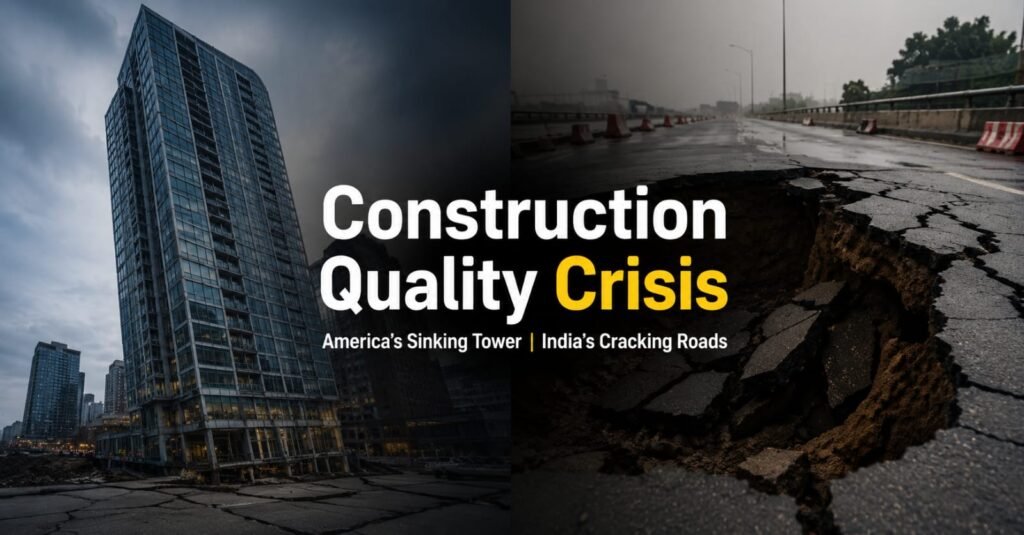
San Francisco’s Millennium Tower: A Symbol of the Construction Quality Crisis That Won’t Go Away
San Francisco’s 58-story Millennium Tower is sinking and tilting due to its foundation resting on friction piles in soft soil rather than bedrock. A $120 million “perimeter pile upgrade” completed in 2023 successfully stopped the northwest corner from sinking further, but the building still leans roughly 28–29 inches, and the center is now experiencing slight, continued settlement.
Key Details on the Situation
Current Status (2025–2026): While the rapid sinking and tilting have been halted, the building is not perfectly stable. The tower is still sinking at its center at roughly one-tenth of an inch per year.
The Fix: A 2022 plan reduced the number of new piles from 52 down to 18, which were installed on the north and west sides to anchor the structure to bedrock.
Residual Tilt: The building still leans roughly 28–29 inches to the northwest, and repair work has only managed to reverse about 1 inch of the tilt — much less than originally predicted.
Impact: The building is considered safe by officials, but the ongoing tilt has significantly lowered property values.
Structural Risks: The elevators are expected to stop working if the lean reaches 40 inches.
Completed in 2009, the luxury tower started sinking almost immediately. By 2016, it had sunk 16 inches, with a 2-inch tilt at the base and a 6-inch tilt at the top. The issue is a combination of a heavy concrete structure and a foundation that did not reach deep bedrock, settling instead in compressible clay and sand.
This is not just an engineering failure — it is a textbook example of the construction quality crisis that emerges when cost-cutting overrules sound structural planning.
This is not just an engineering failure — it is a textbook example of the construction quality crisis that emerges when cost-cutting overrules sound structural planning.
India’s Roads Are Cracking Too — And the Construction Quality Crisis Hits Closer to Home
As of early May 2026, concerns regarding the structural integrity of new expressways before the monsoon have surfaced following reports of damage, alongside significant progress on major infrastructure projects.
Key Structural Issues & Road Damage (May 2026)
Sohna Expressway Sinkhole (Gurugram): A portion of the Sohna Expressway caved in on May 6, 2026, creating a nearly 10-foot-deep sinkhole near Subhash Chowk in Gurugram, Haryana. This marks a recurring issue, with similar massive failures reported in this recently constructed corridor.
Cause of Failure: Preliminary reports attribute the cave-in to erosion in an aging sewer line located beneath the road, causing the structure to buckle before the monsoon season fully begins.
General Concerns: Despite the expansion of the National Highway network, concerns remain over the ongoing construction quality crisis, with some reports noting that high-speed corridors are experiencing issues with rutting and potholes within their first monsoon season — often linked to rapid construction speeds.
Major Projects and Upgrades Moving Forward (May 2026)
Not everything is grim. Amid the construction quality crisis, some landmark projects are nearing completion:
Mumbai–Pune Expressway: The long-awaited 13.3-km “Missing Link” is scheduled for inauguration in 2026, aiming to bypass the congested Khandala ghat section. The project features India’s longest highway tunnel.
Delhi–Mumbai Expressway: The DND-Faridabad-Sohna section is moving toward completion, with key connections in the NCR region expected to finish by mid-2026.
Parel TT Bridge (Mumbai): Concrete work is ongoing on the Parel TT Bridge to improve durability, with completion targeted before the 2026 monsoon.
Infrastructure Status Update: Is India Finally Course-Correcting?
Construction Slowdown: Road construction in FY26 slowed to 9,380 km — the lowest pace since 2017–18 — falling short of the 10,000 km target due to issues in land acquisition.
Stricter Standards: The government is implementing stricter pre-award filters for highway contracts to improve quality, aiming for 90% land acquisition before awarding projects, to avoid future delays and construction compromises.
Slowing down to build it right may be the only real answer to the construction quality crisis.
Final Word: Speed Is Not the Goal — Safety Is
Whether it’s a $120 million repair job on a tilting San Francisco skyscraper or a massive sinkhole swallowing part of a newly built Indian expressway — the pattern is similar. Corners are cut. Deadlines are prioritized. And then the public pays — literally and physically. Countries that enforce strict accountability in construction tend to see fewer such failures. Until India and the U.S. adopt stronger quality enforcement and zero-tolerance standards, the construction quality crisis will likely continue making headlines — and creating risks for ordinary people.z
Found this useful? Share it with someone who commutes daily or owns property near a major construction zone.
Disclaimer: This article is published for informational purposes only. Readers are advised to verify details from official sources before making any decisions. The website is not responsible for any loss or damage arising from the use of this information.