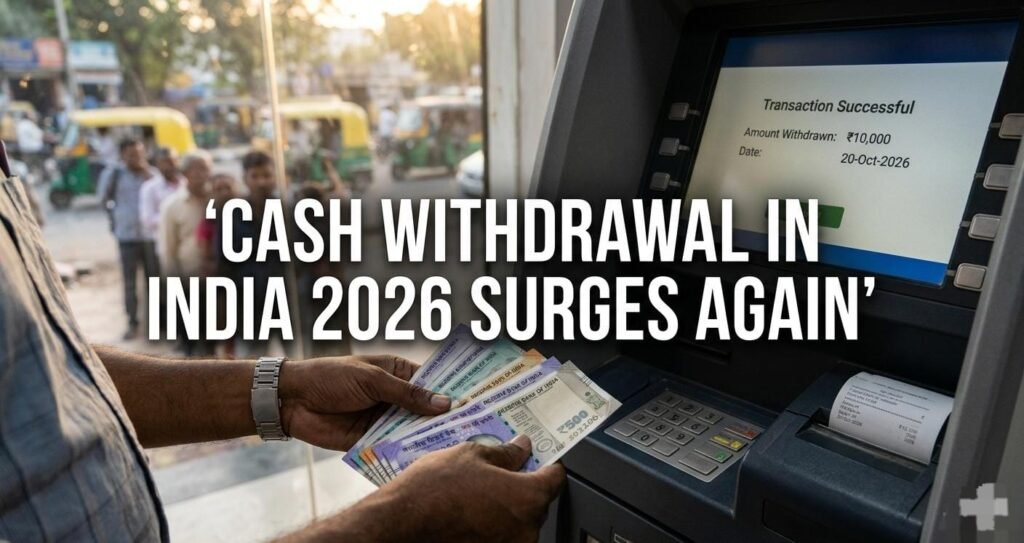
Cash Withdrawal in India 2026 Surges Again: Why Banks Are Seeing Record Outflows Despite UPI Boom
Despite the explosive growth of digital payments, especially UPI, cash withdrawal in India 2026 has once again surged across the country, hitting record levels in circulation and ATM activity. While India is rapidly becoming a digital-first economy, the preference for physical cash remains deeply rooted in cultural habits, rural financial structures, precautionary savings, and policy-driven cash flows.
As of early 2026, Currency in Public Circulation has reached historic highs, showing a clear pattern: digital payments are growing, but cash is not declining. Instead, both systems are expanding side by side, creating a hybrid financial behaviour that defines modern India. The rise in withdrawals has sparked debate about whether this is economic caution, behavioural habit, or structural dependence on cash.
Cultural Roots Driving Cash Withdrawal in India 2026
One of the strongest reasons behind cash withdrawal in India 2026 is India’s long-standing cultural preference for physical money. In many rural and semi-urban regions, cash is still seen as more trustworthy, immediate, and controllable compared to digital alternatives.
Small vendors, daily wage earners, and informal businesses continue to operate primarily in cash due to simplicity and instant settlement. Even in urban areas, cash remains widely used for small-value transactions where people prefer avoiding digital footprints.
This behavioural trust in physical currency is not just economic—it is psychological. Holding cash gives many households a sense of financial security and direct control over spending.
Precautionary Savings and Festival Demand Fueling Cash Flow
Another major factor behind cash withdrawal in India 2026 is rising precautionary savings. Households are increasingly withdrawing and holding cash due to global uncertainty, inflation concerns, and fears of sudden financial disruption.
Social media-driven anxieties and market volatility have also contributed to “cash hoarding behaviour,” where individuals prefer liquidity in hand rather than in banks.
Seasonal demand further amplifies this trend. During festivals like Diwali, wedding seasons, and agricultural cycles, ATM withdrawals spike significantly as families prefer cash-based spending for gifts, shopping, and ceremonies.
Additionally, rising incomes in rural India combined with lower interest rates on deposits have encouraged higher consumption and cash liquidity. Instead of saving in banks, many households prefer keeping money accessible for immediate use.
Government Transfers, Gold Buying, and Informal Economy Impact
Government welfare schemes have also played a key role in cash withdrawal in India 2026. Direct benefit transfers to women and rural households across multiple states have increased cash availability at the grassroots level. In many cases, this money is quickly withdrawn and circulated in local markets.
At the same time, rising gold and silver prices in 2026 have encouraged households to convert bank savings into physical assets. This has further increased cash movement as people liquidate deposits to invest in precious metals.
India’s vast informal economy is another structural reason. A large portion of employment still operates outside formal banking systems. Daily wage payments, small trade, and rural services continue to rely heavily on cash transactions, ensuring constant demand for physical currency.
Digital Trust Gap, Privacy Concerns and GST Anxiety
Even with UPI dominance, trust issues continue to influence cash withdrawal in India 2026. While digital payments are widely accepted, concerns about fraud, scams, and cyber risks remain strong among certain user groups.
In some regions, reports of GST notices linked to high-value digital transactions have created behavioural caution, pushing individuals and small businesses to prefer cash to avoid digital tracking and compliance scrutiny.
Privacy is another factor. Many users prefer cash for transactions they do not want digitally recorded. Although UPI is free and convenient, it still leaves a traceable financial footprint, which some users consciously avoid.
Banking Rules, ATM Charges and Cardless Withdrawal Trends
Recent banking updates have also influenced cash withdrawal in India 2026. Revised ATM rules introduced in 2026 include stricter free withdrawal limits and higher charges beyond permitted transactions. This has changed how often people access cash through traditional banking channels.
At the same time, cardless ATM systems are expanding rapidly, allowing withdrawals via mobile banking apps. This has made cash access more convenient while still reinforcing cash usage in the economy.
Interestingly, data shows that nearly 86% of UPI person-to-merchant transactions remain below ₹500. This highlights a clear behavioural split—digital payments dominate small purchases, while cash is still preferred for larger transactions, savings withdrawal, and informal spending.
Is It a War Effect or Economic Panic?
Despite global geopolitical tensions and foreign portfolio outflows in early 2026, the surge in cash withdrawal is not linked to any banking instability or “war-driven panic.”
Indian banks remain stable and largely domestically supported. Experts clarify that this is not a bank-run scenario but a behavioural and structural liquidity shift.
The Reserve Bank of India continues to monitor currency circulation closely, ensuring stability in both digital and cash ecosystems.
The rise of cash withdrawal in India 2026 shows that India is not moving away from cash but evolving into a dual-system economy where digital and physical money coexist. Cultural habits, informal employment, precautionary savings, and policy changes all continue to shape how Indians manage money.
The future is not cash vs digital—it is cash plus digital working together in a uniquely Indian financial model.
What’s your view—do you think India will ever fully move away from cash, or will both systems always coexist? Share your thoughts in the comments below.
Disclaimer: This article is published for informational purposes only. Readers are advised to verify details from official sources before making any decisions. The website is not responsible for any loss or damage arising from the use of this information.