Will Super El Niño 2026 Trigger 7 Dangerous Global Disasters? Here’s What Experts Fear
Super El Niño 2026: Why Is the World Preparing for a Powerful Climate Event?
Extreme weather is once again becoming the biggest concern across the globe. In this blog, we explain what Super El Niño 2026 could mean for India and the rest of the world, why scientists are closely monitoring the Pacific Ocean, and how this climate pattern may affect rainfall, food prices, agriculture, heatwaves, and global temperatures over the next several months. If current forecasts continue, its impact could extend well into 2027.
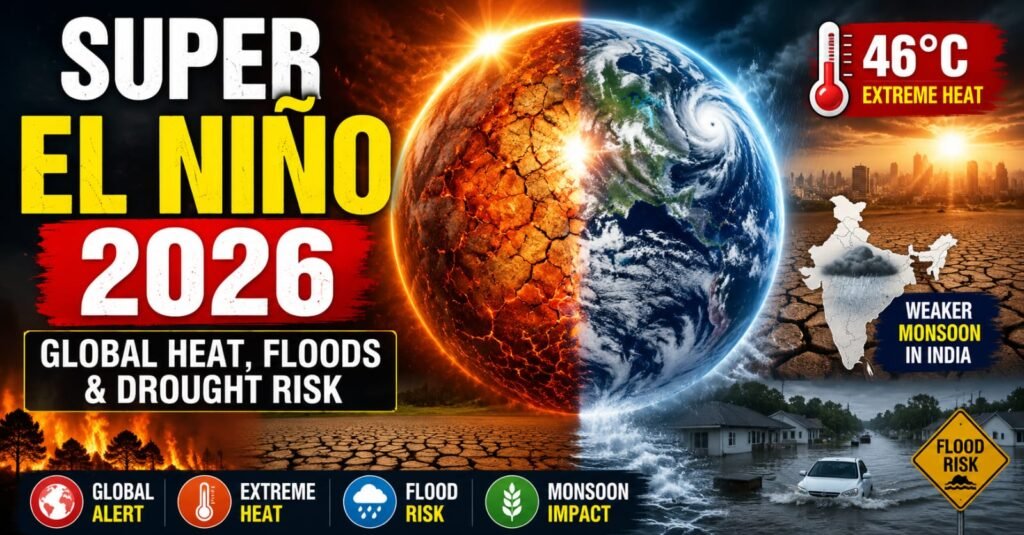
What Is Super El Niño 2026 and Why Is It Important?
Super El Niño 2026 is a climate pattern caused by unusually warm sea surface temperatures in the central and eastern tropical Pacific Ocean. As ocean temperatures rise, atmospheric circulation changes, leading to short-term increases in global temperatures and triggering extreme weather events worldwide.
Its effects are rarely limited to one region. Instead, it can produce severe droughts in some countries while bringing destructive floods to others, making it one of the most influential climate events on Earth.
How Super El Niño 2026 Could Affect India
One of the biggest concerns is India’s monsoon season. El Niño has historically been linked to weaker or delayed monsoons, increasing the risk of below-average rainfall across several regions.
The Indian Meteorological Department (IMD) has reported changing monsoon patterns linked to emerging El Niño conditions. Central and eastern parts of northeast India have already witnessed significant early rainfall variations, creating uncertainty for the kharif crop season.
Both the central and state governments, led by the Union Ministry of Agriculture, are coordinating mitigation efforts to support farmers facing unpredictable rainfall and possible dry spells. Water availability, hydroelectric power generation, and agricultural productivity may all come under pressure if rainfall remains inconsistent.
Global Weather Could Change Dramatically
The effects of Super El Niño 2026 extend far beyond India.
Australia, Indonesia and parts of India frequently experience severe droughts and destructive wildfires during strong El Niño years. In contrast, Peru, Ecuador and the US Gulf Coast often receive excessive rainfall, increasing the risk of flooding.
Southern and East Africa may experience prolonged droughts, while some parts of Europe could see colder or drier winters.
North America’s Midwestern states are also expected to receive reduced rainfall, potentially affecting agricultural production. Meanwhile, heavier rainfall across the southern United States may threaten wheat and cotton crops through flooding.
Pakistan and Nepal could also experience drier-than-normal monsoon conditions. However, occasional slow-moving storms may still produce dangerous flash floods because dry, hardened ground absorbs less water.
Marine Life and Food Supplies Face Growing Pressure
One of the lesser-known impacts of Super El Niño 2026 is its effect on oceans.
The warming Pacific weakens the normal upwelling of cold, nutrient-rich water along the western coast of the Americas. This reduces food availability for marine ecosystems and increases the likelihood of widespread coral bleaching across the world’s oceans.
Agricultural production may also suffer in several countries. Reduced harvests could increase volatility in global prices of wheat, maize, sugar, coffee and chocolate, adding pressure to existing food insecurity caused by economic challenges and ongoing conflicts.
Scientists Warn This Could Become One of the Strongest El Niño Events
Ocean surface temperature anomalies are rising rapidly, raising concerns among scientists that this event could become one of the strongest El Niño episodes recorded since the late nineteenth century.
Forecast models indicate roughly a 63% chance that sea surface temperatures in the Niño 3.4 region could exceed 2.0°C above average, potentially developing into a “Super El Niño” later this year.
The World Meteorological Organization (WMO) estimates an 80% to 90% probability that the event will strengthen significantly, with background climate change likely amplifying its impacts. Scientists warn this could push global temperatures to unprecedented levels and continue influencing weather patterns into early 2027.
The National Oceanic and Atmospheric Administration (NOAA) has already issued an El Niño advisory, urging governments worldwide to prepare for severe weather impacts.
Europe Already Facing Record Heat
The impact of rising temperatures is already becoming visible in Europe. Temperatures have crossed 46°C in several areas, and reports indicate that 212 people have died due to extreme heat. More than 1,000 schools in London have also been closed following a red heat alert, highlighting how dangerous prolonged heatwaves can become.
Super El Niño 2026 has the potential to influence weather, agriculture, food security, energy production and economies across multiple continents. While forecasts continue to evolve, governments, farmers and communities are already preparing for possible disruptions.
Frequently Asked Questions (FAQs)
We will continue bringing you verified climate updates, expert analysis and important weather developments. Stay connected with our website so you never miss the latest updates that matter to you.
Disclaimer: This article is published for informational purposes only. Readers are advised to verify details from official sources before making any decisions. The website is not responsible for any loss or damage arising from the use of this information.