Delhi Airport Plane Collision Shocks Flyers: How Did Two Aircraft Crash Without Takeoff?
From the last year 2025, we have been observing more cases of airplane accidents. Though they may be milder or larger, in both cases the lives of people are at stake. The recent Delhi Airport plane collision has once again raised serious concerns about aviation safety in India.
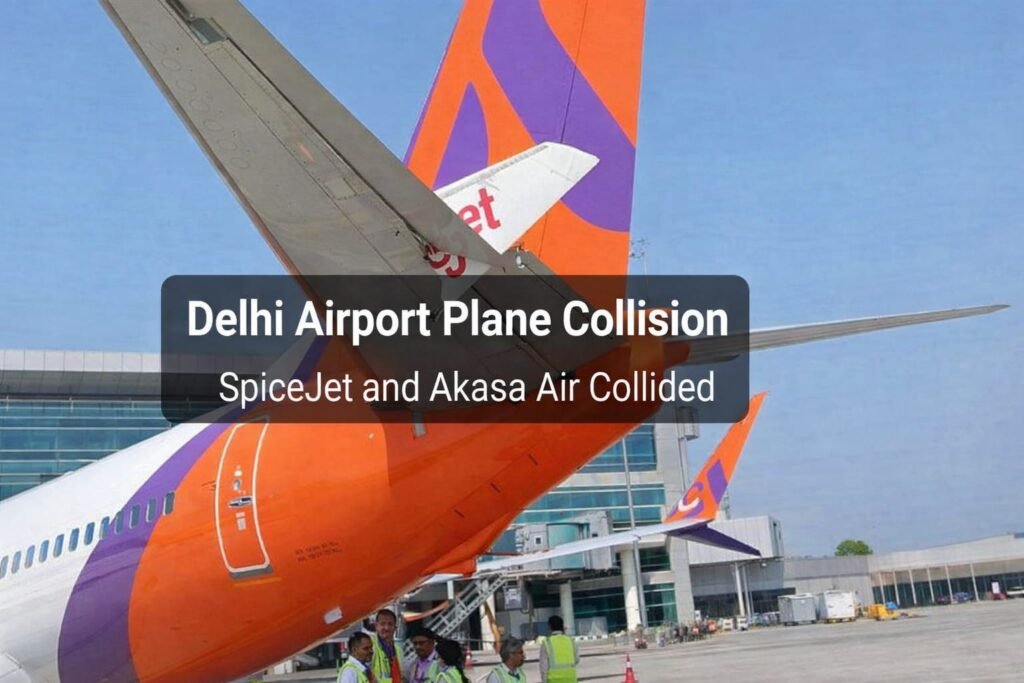
Delhi Airport Plane Collision: What Happened on April 16, 2026?
On April 16, 2026, a SpiceJet Boeing 737-700 and a stationary Akasa Air Boeing 737 MAX 8 collided at Delhi’s Indira Gandhi International Airport (IGI) Terminal 1 during taxiing around 2:15 pm.
The incident occurred when the SpiceJet aircraft, operating on the Leh–Delhi route, struck the parked Akasa Air plane, which was scheduled for a Delhi–Hyderabad flight. The collision happened as the SpiceJet aircraft was taxiing towards bay No. 106 and the Akasa aircraft was positioned near bay No. 104.
Despite the impact, no injuries were reported, but the Delhi Airport plane collision caused visible damage to both aircraft, triggering immediate safety protocols.
How Did the Collision Happen? Key Findings
Preliminary reports have revealed crucial details behind the Delhi Airport plane collision:
The SpiceJet aircraft turned without proper wing-walker clearance during taxiing.
Its right winglet struck the horizontal stabilizer of the stationary Akasa Air plane.
The incident highlights a possible lapse in ground movement coordination.
This Delhi Airport plane collision has raised questions about whether standard operating procedures were properly followed during aircraft movement on the runway.
Immediate Action Taken After the Incident
Authorities responded swiftly after the Delhi Airport plane collision:
The Directorate General of Civil Aviation (DGCA) ordered a detailed investigation.
SpiceJet pilots and the Air Traffic Control (ATC) officer on duty were de-rostered pending inquiry.
Both aircraft were grounded for thorough structural inspection and repairs.
The quick response ensured passenger safety remained the top priority, even as the investigation began.
Second Incident in Two Months Raises Alarm
This is not an isolated case. The Delhi Airport plane collision marks the second such ground incident in just over two months. Earlier, in February, an Air India and IndiGo aircraft were involved in a minor ground collision at Mumbai airport.
Additionally, Delhi airport has witnessed multiple safety-related events over the past year, including:
The repeated occurrence of such incidents is amplifying concerns over aviation safety standards and operational discipline.
Passengers Safe, Flights Disrupted
All passengers and crew members on both flights are reported to be safe. However, the Akasa Air flight scheduled for Hyderabad had to be cancelled due to the Delhi Airport plane collision.
Airlines have arranged alternative flights for affected passengers to minimize inconvenience. Both aircraft will remain grounded until they pass safety inspections and necessary repairs.
Why This Incident Matters More Than It Seems
While no casualties were reported, the Delhi Airport plane collision highlights deeper systemic issues:
Such incidents, even without injuries, can have serious consequences if not addressed promptly. Experts are now calling for stricter monitoring and improved coordination between pilots and ground staff.
DGCA Investigation Underway
The Directorate General of Civil Aviation (DGCA) has launched a full-scale investigation to determine the exact cause of the Delhi Airport plane collision. The findings are expected to play a crucial role in preventing similar incidents in the future.
Is Air Travel Still Safe?
The Delhi Airport plane collision serves as a wake-up call for aviation authorities and airlines alike. While safety systems worked in preventing casualties, the recurrence of such incidents cannot be ignored.
What do you think—is air travel becoming riskier, or are these just isolated cases? Share your thoughts in the comments below!
Disclaimer: This article is published for informational purposes only. Readers are advised to verify details from official sources before making any decisions. The website is not responsible for any loss or damage arising from the use of this information.