Brutal Bolt HR Layoffs: AI Cost-Cutting Push Reshapes Fintech Jobs in 2026
The fintech industry is entering a brutal new phase where cost-cutting and AI automation are no longer limited to small operational changes. Companies are now removing entire departments to survive a slowing market and shrinking valuations. One of the biggest examples comes from Bolt, whose controversial decision to eliminate its Human Resources team has sparked intense debate across the tech world.
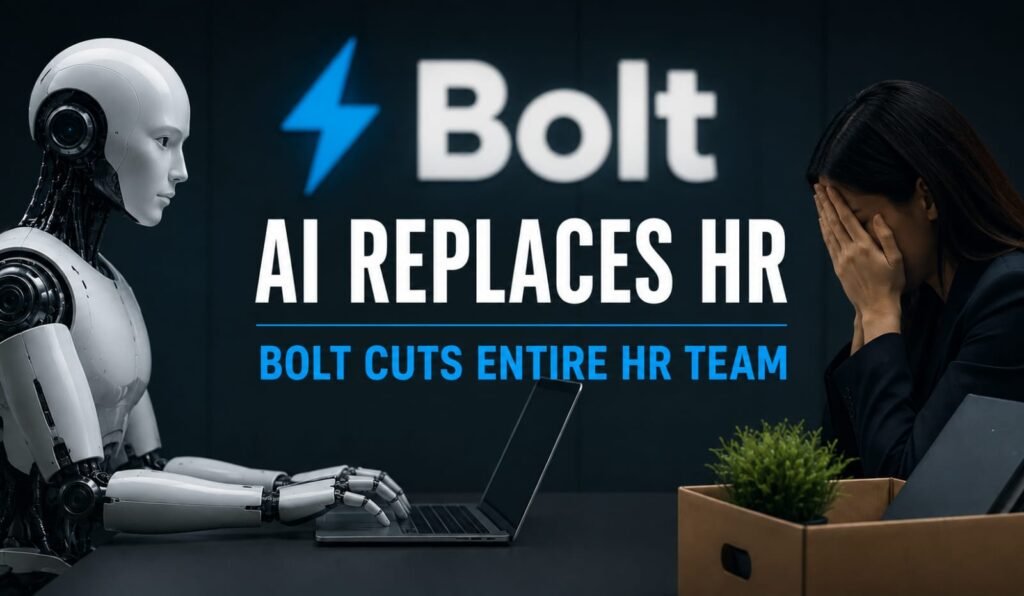
Bolt’s Zero-HR Move Sparks Massive Debate
San Francisco-based fintech company Bolt eliminated its entire Human Resources department and laid off roughly 30% of its workforce in April 2026.
CEO Ryan Breslow defended the decision at the Fortune Workforce Innovation Summit, stating the HR team was “creating problems that didn’t exist.”
The bold and controversial move has now become one of the most talked-about examples of the growing AI-driven restructuring trend in the American fintech sector.
Why Bolt Eliminated Its HR Department
According to co-founder Ryan Breslow, the company needed to shift into a “wartime” startup mode to revive the business after its valuation collapsed from nearly $11 billion in 2022 to roughly $300 million.
The company believed reducing management layers and administrative departments would help improve agility, lower operational expenses, and speed up execution.
This aggressive restructuring has made the Bolt HR layoffs one of the biggest fintech workforce stories of 2026.
What Happened After the Bolt HR Layoffs
Breslow claimed that internal complaints and workplace issues immediately disappeared after the HR department was removed.
Instead of maintaining a full HR structure, Bolt replaced the division with a smaller “People Operations” team focused mainly on onboarding and basic operational support.
Supporters of the decision argue the company became leaner and faster, while critics warn that removing HR entirely could create serious legal, compliance, and workplace culture risks in the future.
AI Automation Is Reshaping Fintech Jobs
The Bolt HR layoffs are part of a much larger transformation happening across the global tech and fintech industry.
Major technology companies like IBM and Oracle have reportedly shifted up to 94% of routine HR tasks and employee queries to AI systems.
Smaller fintech firms are increasingly adopting similar strategies to reduce costs and maximize efficiency during uncertain market conditions.
At the same time, several large fintech and tech firms including PayPal and Block have reduced major portions of their workforce, decreasing demand for recruitment and onboarding teams.
Tech Layoffs Continue Across the Industry
A fresh wave of layoffs has swept across the tech industry in recent weeks, with companies citing AI investment, restructuring, and efficiency drives as key reasons behind workforce reductions.
By current estimates, at least 24,000 workers connected to the U.S. tech sector lost their jobs within just the past few weeks.
The layoffs span cloud infrastructure, fintech, enterprise software, and consumer internet companies, including some of America’s largest technology brands.
Several firms directly linked workforce cuts to rising AI investments and changing hiring priorities.
The growing scale of these layoffs has made the Bolt HR layoffs a symbol of the wider AI-driven transformation happening across Silicon Valley.
Can AI Completely Replace HR Teams?
Despite the rise of automation, industry experts remain divided on whether fully eliminating HR departments is sustainable long-term.
Workplace analysts from platforms like UNLEASH argue that HR professionals still provide critical human judgment, fairness, emotional intelligence, and ethical decision-making that AI systems cannot fully replicate.
Reports also show that some organizations that aggressively replaced employees with AI later rehired staff after discovering operational gaps and cultural issues created by automation.
Because of this, many experts believe the future of HR will not disappear completely but instead evolve into a more strategic, data-focused, and AI-assisted role.
The Future of HR in Fintech
Recruitment data from firms like Frazer Jones suggests companies are increasingly demanding HR leaders with analytics and AI expertise rather than traditional administrative skills.
This means the future workforce may involve smaller HR teams supported heavily by automation instead of complete department removals.
Still, the Bolt HR layoffs have intensified fears that AI-driven restructuring could permanently reduce white-collar job opportunities across the fintech industry.
The Bolt HR layoffs may become either a warning sign or a blueprint for struggling startups trying to survive the AI era. While automation can reduce costs and increase speed, removing human oversight entirely remains a risky experiment that many companies may not successfully replicate.
As AI continues reshaping the global workforce, the biggest question is no longer whether jobs will change — but how far companies are willing to go in replacing humans with machines.
Stay connected for more fintech, AI, business, and global tech industry updates shaping the future economy.
Disclaimer: This article is published for informational purposes only. Readers are advised to verify details from official sources before making any decisions. The website is not responsible for any loss or damage arising from the use of this information.