Nifty 50 Crash Alert: Nifty 50 Slips Below Key Level — Is 25,000 the Next Big Breakdown Amid AI & War Fears?
On Monday, 1 March 2026, the Nifty 50 closed around 25,454 after opening gap down, facing severe downward pressure with high volatility due to AI sector concerns, technical breakdown signals, and geopolitical risks. The Nifty 50 Crash signals are getting stronger as the index struggles to hold crucial support zones.
The immediate outlook remains bearish. As already discussed in our last blog, if Nifty goes below the 25,300 level, then there will be a clear bearish or downtrend. Though it seemed that it would hold its position at 25,000, due to war circumstances the economy is unstable, which is one major reason for the current bearish trend. If it crosses the 25,500 level, then the market will turn bullish again.
Sensex Tanks 961 Points — Key Levels to Watch
The BSE Sensex fell by 961.42 points to settle at 81,287.19, reflecting strong selling pressure across sectors.
Now, the key support for Sensex is around 80,513 – 81,100 and resistance stands at 82,084 – 82,570. The broader market sentiment suggests caution as volatility remains elevated.
Nifty 50 Crash Deepens: Tech Weakness & AI Disruption Fears
The market is currently experiencing significant bearish pressure, with the NIFTY 50 closing down 1.41%, mainly driven by technology sector weakness and concerns over AI disruption. The Nifty 50 Crash is being closely linked to uncertainty in the IT and AI-driven business models.
Metal stocks have been particularly weak due to rising AI-driven supply chain pressure. Technical indicators suggest potential for continuing short-term weakness, with the breach of previous support levels leading to a “sell on rise” market sentiment.
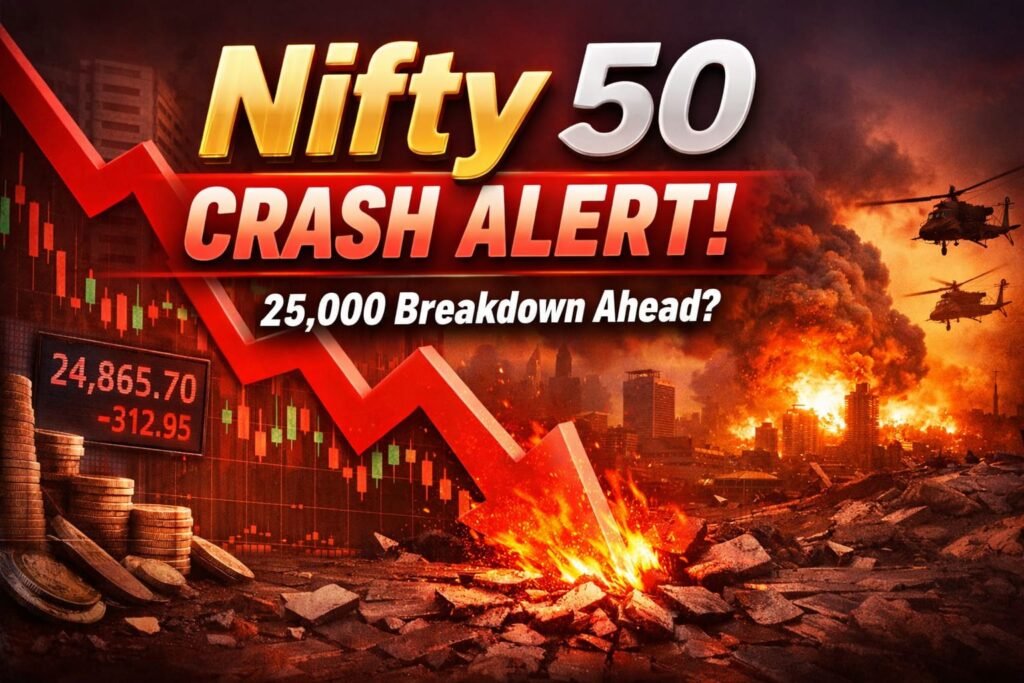
Nifty 50 closed lower by 312.95 points at 24,865.70, with heavy selling in financials, auto, and infra stocks. It hit a high of 24,989.35 during the session before losing momentum.
Near-term support levels are 24,564 – 24,358 and resistance levels are 25,227 – 25,433. The Nifty 50 Crash trend may continue if these supports fail to hold.
Nifty Bank Slides Sharply — All 14 Constituents in Red
The NIFTY Bank closed lower by 689.39 points at 59,839.65. Market breadth remained weak, with all 14 constituents closing in negative territory.
Nifty Bank opened at 59,204.30, touched a low of 59,148, hit a high of 61,177.50, and finally closed at 59,839.65. RSI slipped sharply towards the 40 mark, indicating weakening momentum and sustained selling pressure.
Near-term support levels are 59,242 – 58,873 and resistance levels are 60,437 – 60,806.
Few Stocks Shine Despite Nifty 50 Crash
On the positive side, Bharat Electronics Limited (BEL), Hindalco Industries, Sun Pharmaceutical Industries, Oil and Natural Gas Corporation (ONGC), and ITC Limited showed relative strength.
However, broader sentiment remains cautious as FIIs continue withdrawing funds amid Middle East tensions. Oil prices and inflationary pressures are also visible in India, adding to the uncertainty.
Is AI the Real Trigger Behind the Nifty 50 Crash?
In other words, AI is significantly impacting the IT sector, which has been the biggest cause of selling pressure among investors in recent days. The Nifty 50 Crash narrative is now closely tied to AI-driven disruption fears and global instability.
Due to war circumstances and economic uncertainty, it is advisable to be cautious while investing. However, downtrends can also benefit experienced investors who understand market moves. They often wait for declines to accumulate quality stocks before the market moves upward again.
So, do not lose patience — but be intelligent while making investment decisions during this volatile phase.
Do you think Nifty will break 25,000 next, or stage a sharp rebound above 25,500? Share your market strategy in the comments — let’s discuss where the market is heading next.
Disclaimer: This article is published for informational purposes only. Market Prices are subject to market risks and real-time fluctuations. Readers are advised to verify prices from official sources before making any financial decisions. The website is not responsible for any loss or damage arising from the use of this information.