UGC Fake Universities Shock: 32 Institutions Identified, 644 PhD Admissions Cancelled — Is Your Degree Safe?
In today’s major higher education update, UGC Fake Universities has become one of the biggest concerns for students and parents across India. The latest developments from the University Grants Commission (UGC) reveal serious action against fake institutions and strict implementation of PhD duration rules.
As of 2026, the UGC has identified 32 fake universities across 12 states, marking a shocking 60% increase in such institutions. The highest number of fake universities has been reported in Delhi.
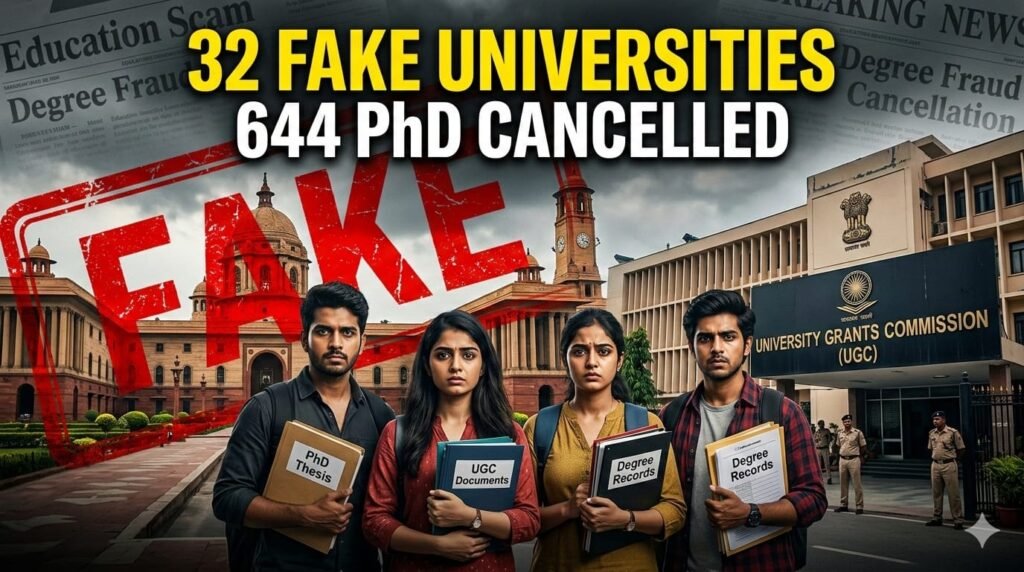
UGC Fake Universities: 32 Institutions Across 12 States Identified
The Commission has clearly stated that degrees awarded by fake institutions will not be valid for employment or further studies. Under the ongoing UGC Fake Universities crackdown, students are advised to verify whether a university is recognized by the Central Government or any State Government before taking admission.
The UGC has urged students and parents to be cautious and seek admission with accurate information. Amidst the growing scope of higher education in the country, fake institutions are operating more aggressively. Enrolling in such unrecognized institutions can result in loss of time, money, and career opportunities.
644 PhD Admissions Cancelled by the University of Mumbai
In another major development, the University of Mumbai cancelled 644 PhD students’ admissions in February due to violation of time limit regulations.
According to UGC regulations, students must complete their PhD program within a minimum of 3 years and a maximum of 6 years, including coursework after admission. An additional 2 years can be granted through a re-registration process, allowing completion up to 8 years from the date of admission.
However, many of the cancelled students had not completed their PhD even after 10 years. This is reportedly the first time such a large number of admissions have been cancelled at once.
Women candidates and persons with disabilities (more than 40%) may be granted relaxation, allowing completion up to 10 years.
Supreme Court Stays 2026 UGC Regulations
The Supreme Court of India stayed the 2026 UGC regulations on January 29, 2026. These regulations were intended to prevent caste-based discrimination in universities but faced controversy over certain definitions.
Meanwhile, a new bill aimed at replacing the University Grants Commission and AICTE is currently under discussion among 39 Ministers.
As of April 2025, the UGC has allowed students to pursue full-time academic programs either in physical mode or in online mode, offering greater flexibility in higher education.
UGC Promotes FIT India and Awareness Campaigns
Alongside strict academic regulation, the UGC is actively promoting the “FIT India Campaign” and requesting universities to organize initiatives such as “Sundays on Cycle Campaign” and the “Bharti Nari to Narayani” convention.
However, the spotlight remains firmly on UGC Fake Universities and the cancellation of long-pending PhD admissions, which have raised serious questions about academic governance.
Why This Matters for Students
Seats being blocked by over-extended PhD candidates created problems for new scholars seeking admission. The enforcement of duration limits is expected to ease admission pressure for fresh applicants.
The Commission has reiterated that degrees from fake universities hold no validity. Under the ongoing UGC Fake Universities action, verification before enrollment is no longer optional — it is essential.
With increasing fake institutions and stricter regulations, students must stay alert, informed, and cautious before making higher education decisions.
Do you think the crackdown under UGC Fake Universities is enough to protect students? Should there be stricter punishment for fake institutions?
Share your thoughts in the comments and let us know your opinion.
Disclaimer: This article is published for informational purposes only. Readers are advised to verify details from official sources before making any decisions. The website is not responsible for any loss or damage arising from the use of this information.