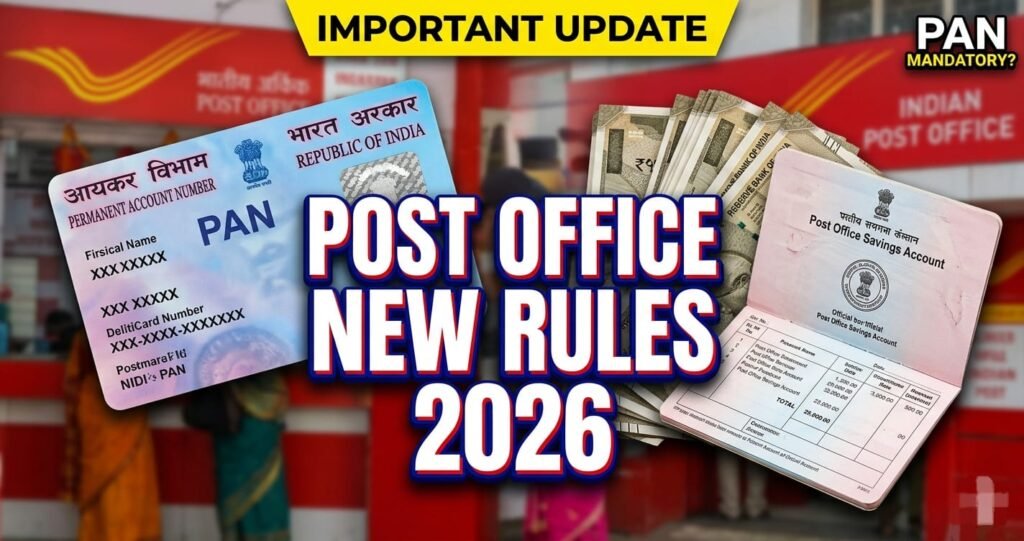
Post Office New Rules 2026: PAN Mandatory? Hidden Changes That Could Affect Your Savings Big Time!
In today’s blog, we cover the Post Office New Rules 2026 that every investor and common user must understand before visiting the post office. Whether you are planning to invest, withdraw money, or open an account, being aware of these updates will help you carry the right documents and avoid last-minute inconvenience.
Post Office New Rules 2026: What Has Changed From April–May
As of April/May 2026, Post Office New Rules 2026 introduce major compliance changes under the Income-tax Rules, 2026. These rules mainly focus on identity verification, tax compliance, and digital modernization.
Mandatory PAN/Aadhaar Rule Explained
Under the Post Office New Rules 2026, PAN is now required for:
For deposits or withdrawals exceeding ₹20 lakh annually, providing PAN or Aadhaar is mandatory.
No PAN? You Must Fill Form 97
If a PAN is not available, the Post Office New Rules 2026 require customers to submit Form 97.
This form includes:
Name
Address
Transaction details
Without this, your transaction may not be processed.
Big Change in TDS Forms: Form 121 Introduced
A major update in Post Office New Rules 2026 is the introduction of Form 121, replacing Forms 15G and 15H.
This new form helps:
Prevent TDS on interest income
Simplify tax compliance
Transaction Tracking Gets Stricter
The Post Office New Rules 2026 aim to strengthen financial monitoring:
Better tracking of high-value transactions
Reduced chances of tax evasion
Increased transparency
Money Order Limit Increased
A user-friendly update in Post Office New Rules 2026:
Money order limit increased to ₹10,000
This improves convenience for sending funds.
DIGIPIN: India’s New Digital Address System
The Post Office New Rules 2026 introduce DIGIPIN, a 10-character alphanumeric geo-coded address system.
This will:
Improve delivery accuracy
Enable digital addressing across India
Why These Post Office New Rules 2026 Were Introduced
Compliance and Financial Integrity
Mandatory PAN ensures proper tracking of transactions under the Income-tax Rules, 2026.
Modernization and Digitalization
The Post Office Act 2023 replaced the 1898 Act to:
Modernize operations
Regulate private couriers
Introduce digital services
Operational Efficiency
Service merging like Registered Post with Speed Post (planned September 2025) aims to:
Improve delivery speed
Enhance tracking
Higher Investment Limits Benefit Investors
Recent updates linked with Post Office New Rules 2026 include:
SCSS limit increased from ₹15 lakh to ₹30 lakh
POMIS limit increased to ₹9 lakh (single) and ₹15 lakh (joint)
Automatic Interest Payments Now Mandatory
From April 1, 2026:
Savings account linking is compulsory
Interest for SCSS, MIS, and Time Deposits will be automatically credited
This ensures secure and hassle-free payments.
Disadvantages & Key Concerns You Should Know
Reduced Liability & Accountability
Section 10 of the Post Office Act 2023 protects the post office from liability for lost or delayed items.
Interception Concerns
Section 9 allows authorities to open or detain postal items on security grounds.
Stricter Early Withdrawal Penalty
Premature withdrawal rules are tougher now.
Example: A 5-year FD closed after 4 years earns only 4% interest.
Removal of Misconduct Penalties
Earlier penalties for fraud or misconduct by officials have been removed.
Benefits: Why Post Office New Rules 2026 Can Still Be Good
High Guaranteed Returns
Interest rates (April–June 2026) remain unchanged for the eighth consecutive quarter.
Government-Backed Safety
Investments are fully backed by the Government of India.
Tax Benefits
Schemes like PPF, SSY, and NSC offer deductions under Section 80C.
Stable Income Option
POMIS offers 7.4% returns, ideal for retirees.
Final Take: Should You Be Worried or Prepared?
The Post Office New Rules 2026 bring a mix of stricter compliance and better financial security. While documentation requirements have increased, these changes aim to make the system more transparent, secure, and efficient for long-term investors.
What do you think about these Post Office New Rules 2026?
Will stricter rules make investing safer or more complicated? Share your thoughts in the comments below!
Disclaimer: This article is published for informational purposes only. Readers are advised to verify details from official sources before making any decisions. The website is not responsible for any loss or damage arising from the use of this information.