India-Nepal Border Crisis 2026: Thousands of Trucks Stuck, New Nepal Vehicle Rules Trigger Panic Among Traders
India-Nepal Border Crisis 2026 Sparks Massive Cargo Jam and Trade Fears
In today’s blog, we are going to explain the fast-growing India-Nepal Border Crisis 2026 that has left thousands of cargo trucks stranded at key checkpoints, triggered fears of shortages in Nepal, and created confusion for Indian travelers entering Nepal with private vehicles. From strict MRP labeling rules to new digital vehicle permit systems, the situation is now affecting traders, transporters, tourists, and daily supply chains on both sides of the border.
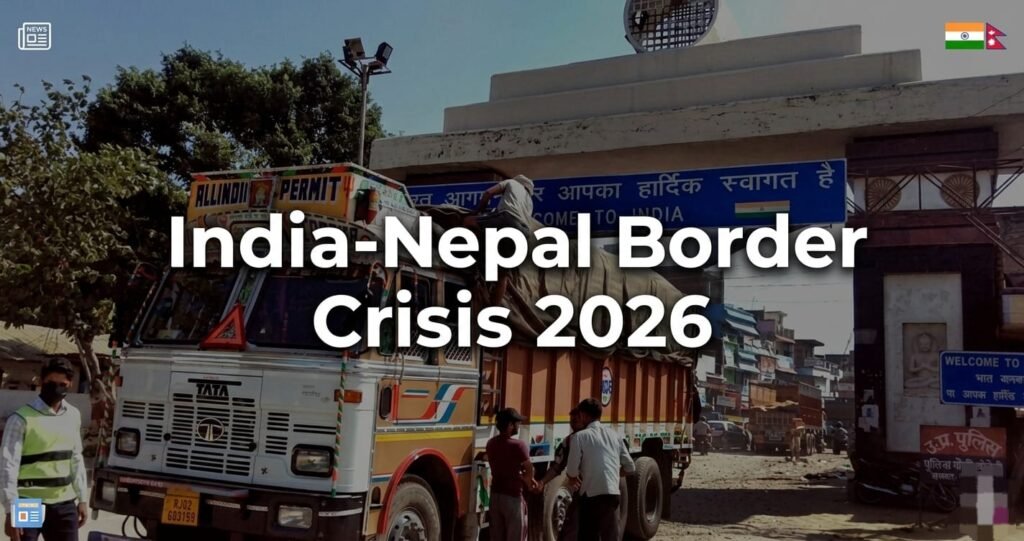
Thousands of Cargo Trucks Stranded at Major India-Nepal Border Points
As of May 7, 2026, thousands of cargo trucks are currently stranded at major India-Nepal border points due to a deadlock over a new customs regulation mandating Maximum Retail Price (MRP) labeling on imported goods.
The India-Nepal Border Crisis 2026 intensified after the Nepal government, referred to as the “Balen administration,” strictly enforced a rule requiring all finished goods to have MRP labels before customs clearance. Although the rule was introduced on April 28, 2024, enforcement has reportedly become much stricter in recent weeks.
Traders and importers have strongly opposed the move, claiming the regulation is impractical and difficult to implement for already-loaded consignments. As a result, customs clearance at several checkpoints has nearly stopped.
Major Border Points Facing Heavy Backlog
Birgunj-Raxaul Border
More than 1,400 trucks are reportedly stuck at the Birgunj-Raxaul border point as customs clearance has remained almost halted for over a week.
Biratnagar-Rani Integrated Check Post
Over 400 trucks are stranded at the Integrated Customs Check Post (ICP) in Biratnagar-Rani, creating long queues stretching for miles.
Total Cargo Backlog
Reports suggest that more than 1,000 containers are currently stuck across various India-Nepal border routes, making the India-Nepal Border Crisis 2026 one of the biggest trade disruptions in recent months.
Violent Protests and Border Disruptions Worsen Situation
The India-Nepal Border Crisis 2026 has its roots in a series of violent protests and border disruptions that shook Nepal as far back as September 2025.
Hundreds of trucks were reportedly stranded at border points including Sonauli and Panitanki during that period due to widespread unrest, cargo attacks, and severe transportation disruptions. Several reports from that time claimed that cargo vehicles were burned, damaged, or seized amid the protests.
At the peak of those disruptions, more than 300 to 1,000 trucks were stuck at different checkpoints, causing significant delays in trade, fuel supply, and perishable goods transportation.
Although those protests have since subsided, the instability they created never fully resolved. The lingering uncertainty from that period has continued to pile pressure on border authorities and transport companies — pressure that has now compounded sharply with the latest customs MRP labeling rules introduced in May 2026.
New Nepal Vehicle Entry Rules for Indians in 2026
Alongside the cargo crisis, Nepal has now implemented stricter and fully digital entry rules for Indian-registered vehicles as of May 2026.
Under the updated system, Indian vehicles entering Nepal must complete online registration for permits through the Department of Customs’ Temporary Import of Vehicle (TIV) module.
Once registered, travelers receive a QR code for border entry.
Key Changes Under New Nepal Entry Rules
Mandatory Daily Fees
Indian vehicles are now required to pay mandatory daily fees, generally ranging between INR 300–500 depending on vehicle type.
Payments can be completed online or directly at border checkpoints.
30-Day Stay Limit
Indian vehicles can now stay in Nepal for a maximum of 30 days per calendar year.
Strict Enforcement
Vehicles without valid or active permits may be treated as illegal by officials, potentially leading to seizure or auction.
One-Day Pass System
Travelers making quick visits near border areas can apply for a one-day pass. However, the vehicle must exit from the same border point on the same day.
Essential Documents Indian Travelers Must Carry
Travelers entering Nepal must now carry:
Original Registration Certificate (RC)
Valid Driving License
Vehicle Insurance covering Nepal travel
Border permit or Bhansar documentation
Travelers are also being advised to carry smaller Indian currency notes, as higher denomination notes like Rs 500 may not always be accepted in certain areas.
Permit extensions can be completed online or through local customs offices before expiry.
Why the India-Nepal Border Crisis 2026 Matters
The current India-Nepal Border Crisis 2026 is not just a transport issue. It is directly affecting trade, tourism, market prices, and cross-border movement between two closely connected neighboring countries.
If the deadlock continues for longer, experts fear deeper shortages, rising inflation, and larger disruptions in South Asian regional trade routes.
What do you think about Nepal’s new MRP rule and vehicle permit system? Should traders accept the changes, or should the government relax the regulations? Share your thoughts in the comments and let us know whether these new rules will improve border management or create bigger problems for travelers and businesses.
Disclaimer: This article is published for informational purposes only. Readers are advised to verify details from official sources before making any decisions. The website is not responsible for any loss or damage arising from the use of this information.