India Gas Crisis 2026: Why LPG May Soon Disappear from Urban Homes
Everyone is surprised why this blog has been made as it seems to be related to science, but it is today’s demand. With rising global tensions and fuel uncertainty, understanding the India gas crisis 2026 is no longer optional—it’s essential for every household and vehicle owner.
PNG, LPG, LNG, and CNG differ primarily in composition, storage, and use. LPG (propane/butane) is bottled for cooking, while PNG (methane) is piped to homes. CNG (compressed methane) fuels vehicles, and LNG (liquid methane) is transported in bulk via sea. All are cleaner alternatives to traditional fuels but differ in handling.
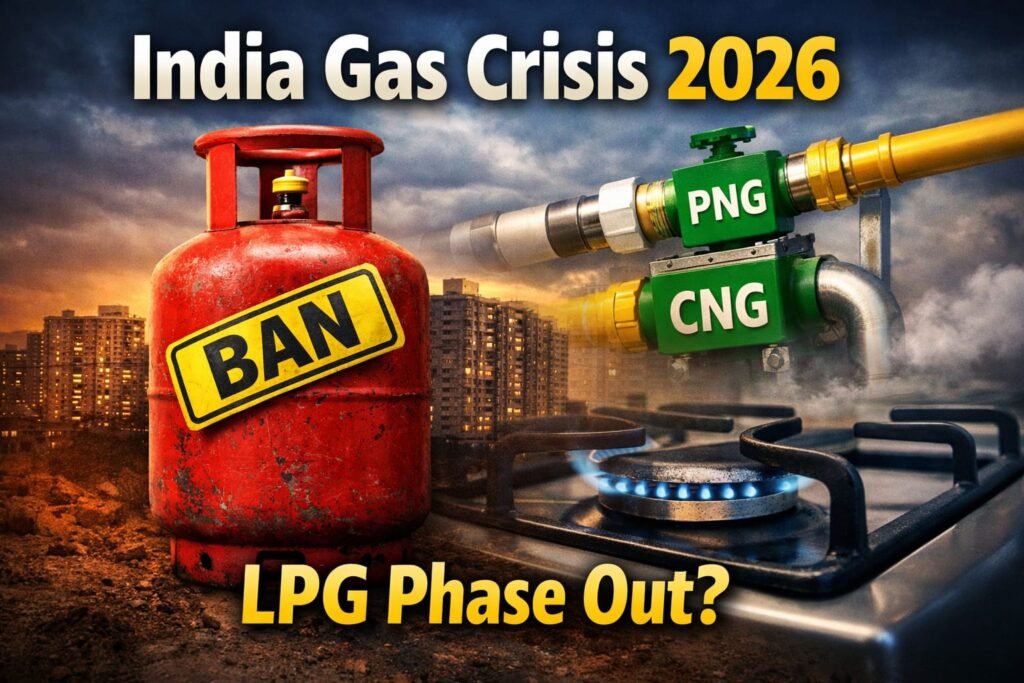
Why These Fuel Types Are Not the Same
Supply Method: LPG requires cylinder exchanges, while PNG is a continuous pipe supply.
Storage: CNG needs high-pressure tanks, while LNG requires highly insulated cryogenic tanks.
Use Cases: CNG is tailored for urban transport (buses, cars), while LNG is used for massive energy needs such as large industries and shipping due to higher energy density.
Density: LPG is heavier than air (settles), whereas PNG/CNG/LNG are lighter than air (disperse).
India’s Big Energy Shift in 2026
India is actively strengthening its energy security by prioritising domestic natural gas allocation (PNG, CNG, and LPG production) to combat import disruptions (about 50% reliance). The government is pushing a rapid transition from LPG cylinders to piped natural gas (PNG) in urban areas, while CNG continues to expand as a primary auto fuel, especially with increased domestic production.
This shift clearly reflects the growing urgency of the India gas crisis 2026 and its impact on everyday life.
Status of Gas Types in India (March 2026)
PNG (Piped Natural Gas)
Over 1.59 crore households use PNG. The government has mandated a transition from LPG to PNG where available, with a 3-month window for switching before potentially discontinuing LPG in those areas. Price in metros like Mumbai is stable around ₹50/SCM.
Also Read: PNG Mandatory in India 2026: 90-Day Deadline to Switch or Lose LPG – Big Energy Shift Explained
LPG (Liquefied Petroleum Gas)
Despite supply pressures from the West Asia conflict (Strait of Hormuz), the government has assured no shortage by increasing domestic refinery production. It remains the primary cooking fuel for households without PNG access.
CNG (Compressed Natural Gas)
Second-largest auto fuel after petrol, with rapid expansion of stations. It is heavily prioritized for supply to ensure urban transportation continues without disruption, especially during the India gas crisis 2026.
LNG (Liquefied Natural Gas)
Essential for balancing the energy mix, with imports from countries like Qatar and the US. High reliance (50%+) makes it vulnerable to global price surges, adding pressure amid the India gas crisis 2026.
Key Trends & Strategic Shift
Prioritisation: The government has invoked the Essential Commodities Act to ensure 100% supply of natural gas to LPG production, CNG, and PNG.
Infrastructure Growth: Target to expand City Gas Distribution (CGD) to over 95% of the population, aiming for 17,500+ CNG stations.
Diversification: India is actively diversifying LNG import sources to reduce dependency on a single region, a crucial step during the India gas crisis 2026.
What It Means for You
As of March 2026, the shift toward PNG and CNG is enhancing energy security and providing cleaner, cheaper fuel for households and vehicles. Meanwhile, reliance on imported LPG and LNG has caused shortages and price shocks due to Middle East supply disruptions.
The government is mandating a transition from LPG to PNG in urban areas to reduce dependency on volatile international markets. It has also invoked the Essential Commodities Act, prioritizing residential PNG and vehicle CNG over industrial consumption to protect citizens from the escalating West Asia conflict’s impact.
Understanding the India gas crisis 2026 can help you stay prepared—whether it’s choosing the right fuel for your home or planning future vehicle expenses.
One should be aware of their differences, need, and availability during times of tension—knowing which source should be used or avoided can make a real difference in the India gas crisis 2026.
Are you ready for this shift from LPG to PNG, or will cylinders still be your choice? Share your thoughts below—your opinion matters!
Disclaimer: This article is published for informational purposes only. Readers are advised to verify details from official sources before making any decisions. The website is not responsible for any loss or damage arising from the use of this information.