Kedarnath Non-Hindu Entry Ban 2026: What’s Really Happening Will Surprise You
In our earlier blogs, we have given detailed information about the non-Hindus ban in Uttarakhand. Today, after the opening of Kedarnath, there is a reported case of one non-Hindu being on the way to the Kedarnath temple — reigniting debate around the Kedarnath Non-Hindu Entry Ban.
But what is the actual truth behind this? The reality is far more nuanced than what viral posts are suggesting.
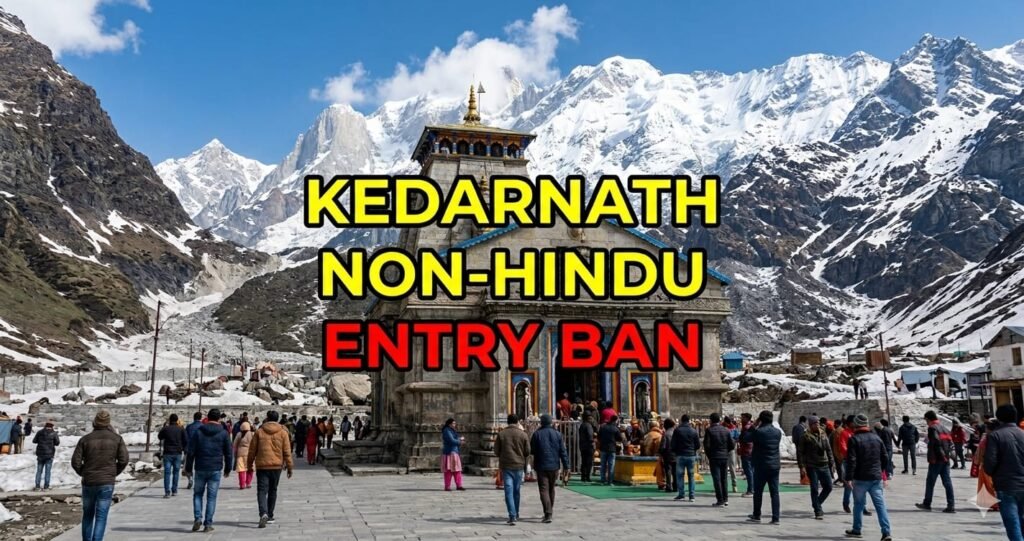
Kedarnath Non-Hindu Entry Ban 2026: The Reality Explained
Based on recent reports from early 2026, the reality behind the Kedarnath Non-Hindu Entry Ban and similar restrictions in Badrinath is not a blanket government-enforced law banning all Muslims or non-Hindus.
Instead, it is a resolution passed by the Badrinath-Kedarnath Temple Committee (BKTC) to restrict entry of “non-Sanatanis” (non-Hindus) into 47 temples under its jurisdiction.
What is Actually Happening
Committee Restriction, Not State Law
The BKTC passed a resolution in March 2026 to prohibit “non-Hindus” from entering the temple complexes and sanctum sanctorum.
Scope of the Rule
This applies to 47 temples, including Kedarnath and Badrinath.
Who is Considered ‘Non-Sanatani’?
The restriction targets those who do not follow Sanatan Dharma.
However, Sikhs, Buddhists, and Jains are generally exempted as they are considered part of the broader Sanatan tradition.
Conditional Entry Possibility
In some cases, non-Hindus may be allowed entry if they submit an affidavit declaring faith in temple traditions.
Implementation Timeline
The committee planned to implement this during the 2026 Char Dham Yatra, with signboards and monitoring systems.
Kedarnath Non-Hindu Entry Ban: What Is NOT True
There are several misconceptions spreading rapidly online about the Kedarnath Non-Hindu Entry Ban:
“Nationwide Law”
This is not a law by the Government of India.
“All Muslims Banned from Uttarakhand”
The restriction is only for temple premises, not the state or travel routes.
“People Being Removed from the Area”
There is no blanket expulsion of residents or visitors.
Temple vs Town: The Most Important Difference
One key point often ignored in the Kedarnath Non-Hindu Entry Ban debate is:
The restriction applies only inside the temple complex
It does not apply to Kedarnath town, hotels, shops, or the yatra route
This distinction is crucial but often misunderstood.
Why This Rule Was Introduced
This distinction is crucial but often misunderstood.
The move behind the Kedarnath Non-Hindu Entry Ban is being driven by temple authorities, priests, and some political leaders.
They argue:
Kedarnath is a center of faith, not a tourist destination
Entry should be limited to those with genuine belief in Sanatan Dharma
Key Justifications
Spiritual Atmosphere
Ensures a focused environment for worship and reflection
Protection of Traditions
Rooted in customs dating back to Adi Shankaracharya
Preventing Misconduct
Addresses concerns like:
Visitors treating temples as picnic spots
Bringing non-vegetarian food
Disruptive photography or videography
Historical Context
Similar restrictions in temples like Jagannath Puri were introduced after historical invasions
Religious Rights (Article 26)
Religious bodies have the constitutional right to manage their own affairs
The Bigger Debate: Faith vs Inclusivity
The Kedarnath Non-Hindu Entry Ban has sparked a nationwide debate:
Should religious institutions have complete control over entry?
Does this conflict with constitutional values of inclusivity?
What impact will it have on tourism and local businesses?
This issue sits at the intersection of faith, law, and modern society.
Final Take: What You Should Understand
The Kedarnath Non-Hindu Entry Ban is:
A temple committee resolution
Limited to temple premises only
Not a government-enforced statewide ban
Understanding this distinction is key to separating facts from viral misinformation.
Do you think such restrictions protect tradition or limit inclusivity? Drop your thoughts below — your perspective might surprise others.
Disclaimer: This article is published for informational purposes only. Readers are advised to verify details from official sources before making any decisions. The website is not responsible for any loss or damage arising from the use of this information.