India Poverty Rate 2026: 2.6% Extreme Poverty, A Remarkable Decline – But Who Is Still Struggling?
India is progressing, and the latest World Bank report brings encouraging news about poverty reduction. Millions of people have moved out of poverty over the past decade. But does this improvement mean that every Indian household is living comfortably? Rising prices, unemployment, income inequality and low wages continue to affect everyday life. Let’s understand what the latest figures reveal and what challenges still remain.
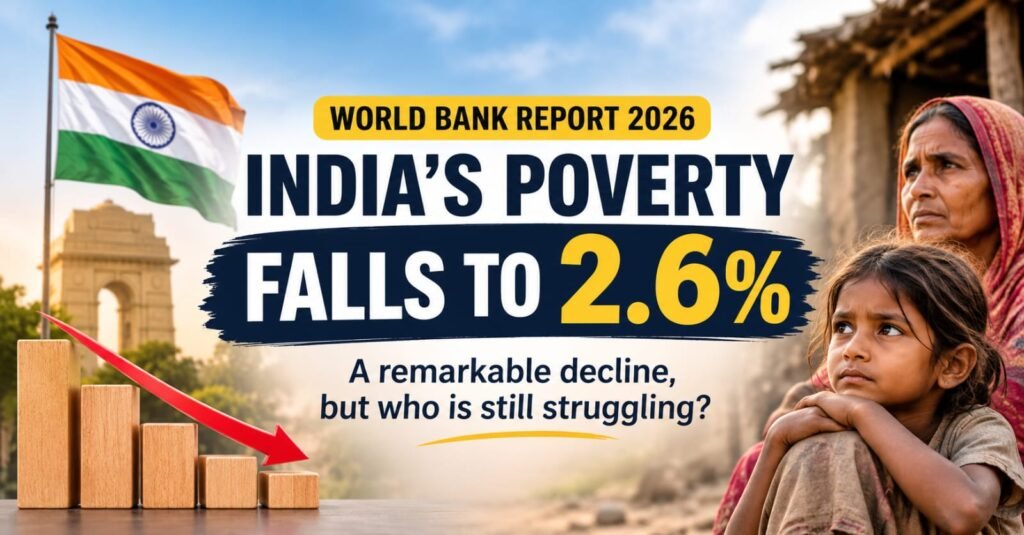
India Poverty Rate 2026: What Does the World Bank Report Say?
According to the World Bank’s October 2026 Poverty and Equity Brief, India’s extreme poverty rate declined from 27.1% in 2011–12 to just 2.6% in 2023–24.
This means approximately 75 million people were still living in extreme poverty in 2023–24, despite the significant improvement.
The report also highlights another important achievement:
These figures use international poverty benchmarks adjusted for purchasing power parity (PPP), not direct currency conversion.
Rural vs Urban Poverty: The Gap Still Exists
Despite the improvement in India Poverty Rate 2026, poverty remains higher in rural India than in urban areas.
Under the $4.20 daily poverty benchmark, rural poverty stood at 19.3%, compared with 8.6% in urban areas.
Around 57% of India’s remaining poor population is concentrated in a geographical belt stretching from Uttar Pradesh to West Bengal.
This highlights how economic development is not equally distributed across the country.
India Poverty Rate 2026:Bihar Remains Among India’s Poorest States
When discussing India’s poverty situation, Bihar deserves special attention.
Bihar continues to record the country’s lowest per capita income among states. Its per capita income was approximately ₹69,321 in 2024–25, according to state government statistics.
Some major challenges include:
Jharkhand, Meghalaya, Madhya Pradesh and Uttar Pradesh also face significant development challenges.
India Poverty Rate 2026: Why Is Poverty Declining in India?
The World Bank identifies several factors behind India’s poverty reduction:
Strong Consumption Growth: Household spending and consumption improved across rural and urban areas, reflecting better economic conditions.
Employment Growth: Employment increased by approximately 134 million between 2017 and 2023, outpacing the growth of the working-age population.
Female Labour Force Participation: More women, particularly in rural areas, entered economic activities, increasing the number of earning members in households.
Government Welfare Schemes: Direct Benefit Transfers (DBT), the Jan Dhan-Aadhaar-Mobile (JAM) framework and food subsidy programmes such as PMGKAY provided financial support to vulnerable households.
Rural Economic Diversification: A gradual shift towards construction and other non-farm activities created additional earning opportunities beyond traditional agriculture.
India’s Poverty Rate 2026: The Reality Behind Average Income
Here comes another important question: If poverty is declining, why do so many people still struggle financially?
India’s per capita Net National Income is an economic average, not the actual salary received by every individual.
The latest PLFS 2025 figures show:
These averages hide considerable differences between workers, occupations and genders.
The World Bank has also highlighted income inequality, with median earnings among the top 10% of workers approximately 13 times those of the bottom 10%.
Youth unemployment and stagnant real earnings remain important concerns, even as employment opportunities expand.
Also Read: Delhi Vehicle Entry Rules 2026: 5 Crucial Restrictions That Could Cause Trouble for Drivers
What Does India’s Poverty Decline Mean for Ordinary People?
The decline in poverty is undoubtedly an encouraging achievement. However, economic progress should not only be measured by how many people cross an international poverty line.
It should also be measured by whether families can afford essential goods, whether young people can find stable employment, whether workers receive fair wages and whether rural households have access to better opportunities.
India Poverty Rate 2026 tells us that the country has made considerable progress, but the journey towards inclusive prosperity is not over.
India is moving forward, but the real question is whether this progress is reaching every household.
What matters is not just reducing poverty on paper, but making everyday life more affordable and secure for ordinary Indians.
Frequently Asked Questions (FAQs)
Keep visiting Akhbaar India for more such news, reports and stories that help you understand the issues shaping our country. Because understanding India’s progress also means understanding the challenges that remain.
Disclaimer: This article is published for informational purposes only. Readers are advised to verify details from official sources before making any decisions. The website is not responsible for any loss or damage arising from the use of this information.