Stock Market Update After Budget: Sharp Reaction Shakes Investor Confidence
Every year, countries and citizens place high hopes on the Union Budget. The public looks forward to relief, growth, and betterment. When expectations are not met, disappointment follows. A similar situation unfolded with the 2026 Budget, which brought more disappointment than satisfaction for many sections of society. While the government’s concern remains focused on long-term development and positioning India among developed nations, the immediate public reaction remained mixed.
As with every policy decision, the budget has two sides — positive and negative. Some sections appeared content, while others were left in shock. The biggest and most visible impact was seen in the stock market, which reacted sharply after the budget presentation.
Stock Market Update After Budget: Biggest Budget-Day Crash in Three Years
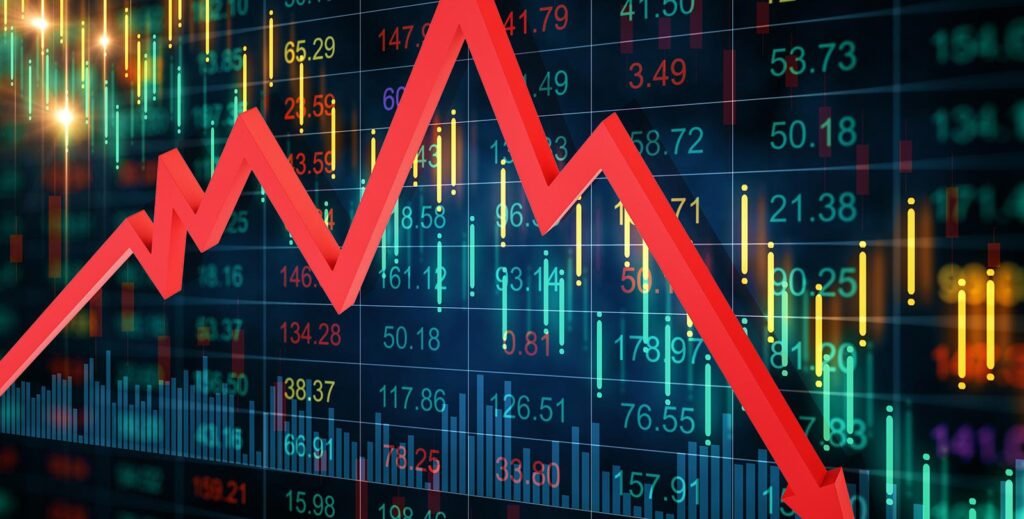
The stock market witnessed a sudden crash immediately after the budget. This fall resulted in heavy losses for investors. The Nifty 50 slipped from 25,000 to 24,800, marking the biggest budget-day crash in the last three years. The sharp decline reflected investor nervousness and policy-related concerns.
One of the major triggers behind this fall was the hike in Securities Transaction Tax (STT), which was already discussed earlier in budget-related analysis.
STT Hike and Buyback Tax Trigger Selling Pressure
The government increased STT on futures from 0.02% to 0.05% and on options from 0.10% to 0.15%, effectively increasing the cost for traders. This move directly impacted derivatives traders and short-term participants, triggering panic selling.
Another factor was the proposed taxation on share buybacks, where buybacks are now treated as capital gains for shareholders. This led to increased selling pressure across the market.
PSU banks declined by 5.57%, metals fell 4.05%, and sectors like oil and gas were also affected. All these factors collectively had a negative impact on market sentiment.
Also Read: Budget 2026 Highlights: What India’s Most Awaited Financial Plan Brings for Growth and Development
Stock Market Update After Budget: Massive Wealth Erosion
Investor wealth took a major hit, with an estimated loss of nearly ₹10 lakh crore, the biggest seen over the last six years. The Sensex fell nearly 1,500 points, closing below 80,700, which is considered a crucial resistance zone.
On the downside, markets could test 79,700 on Sensex and 24,300 on Nifty, as volatility remains high. On the upside, levels near 81,900 on Sensex and 25,300 on Nifty are key, based on the 200-day SMA.
Technical Indicators Signal Short-Term Weakness
Bank Nifty slipped below both its 20-day and 50-day EMA, forming a bearish candle with a lower shadow, indicating short-term weakness. Historical data shows that in the last 15 years, Nifty closed higher on budget day only 8 times. In years like 2010, 2022, and 2025, markets traded lower ahead of the budget, showing a recurring pattern.
Small-cap stocks declined by nearly 3%, while large-cap stocks fell around 2%. Markets were already under stress, and heavy volatility continued.
Stock Market Update After Budget: FII Selling Adds Pressure
Foreign Institutional Investors (FIIs) continued selling amid budget disappointment. Market participants were expecting relief on LTCG and STCG taxation, but no such announcement was made. This further dampened sentiment.
While these tax hikes may work well in the long term, they acted as short-term dampeners for market confidence.
Long-Term Hope Amid Short-Term Pain
There is always a ray of hope in the long term. The biggest losers in such phases are intraday and short-term investors. Understanding market trends and behavior over the last 25 years remains the best policy for becoming a profitable investor or a knowledgeable trader.
The stock market is not gambling; it is a game of mind, discipline, and knowledge. Learning from past mistakes and managing entry and exit points is the real secret of the market.
Stock Market Update After Budget: Market Bounces Back Strongly
Despite the initial shock, the market showed resilience. The Sensex rose 959 points, and investors gained nearly ₹5 lakh crore in a single session. Monday’s market remained volatile, but strong buying in the last hour ensured a solid rebound.
Nifty gained 200 points, with strong buying seen in large-cap stocks. BSE top shares joined the rally. Power Grid surged 7%, indicating strong buying interest and value accumulation.
This rebound proves that market trends remain intact. After a sudden fall during the special trading session on Sunday, buyers stepped in, reflecting a classic momentum-based buying strategy.
This rebound proves that market trends remain intact. After a sudden fall during the special trading session on Sunday, buyers stepped in, reflecting a classic momentum-based buying strategy.
Yesterday on 2nd February 2026 the market makes corrections and nifty 50 closes above 25000 this gives hope towards a positive outlook instead of a stt hike.if u want more information about market trends then write in the comment section