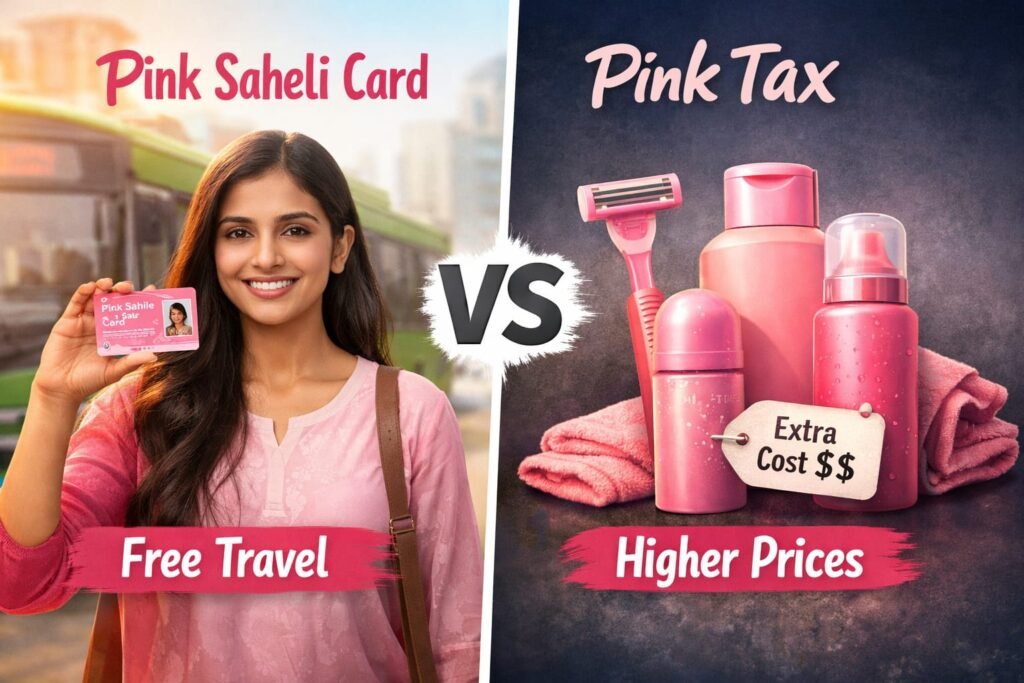
Pink Tax vs Pink Saheli Card: Women’s Day Special — One Gives Free Travel, The Other Quietly Takes Your Money
On the occasion of International Women’s Day, conversations around women’s empowerment, financial independence, and equality take center stage. But while governments introduce schemes to support women, many hidden practices in the market still quietly affect their wallets.
One such important discussion is Pink Tax vs Pink Saheli Card. While one is a government initiative designed to support women economically, the other is a subtle pricing strategy that many consumers never notice while shopping.
Understanding the difference between Pink Tax vs Pink Saheli Card can help people become more aware of how policies support women while certain market practices may do the opposite.
Pink Saheli Card: A Travel Benefit for Women
The Pink Saheli Card is a 2026 Delhi government digital smart card providing free bus travel for women. It is designed to improve accessibility, safety, and affordability of public transportation for women and transgender residents in the capital.
Under this initiative, eligible commuters can travel free on Delhi Transport Corporation (DTC) buses using a digital smart card instead of paper tickets.
The Pink Saheli Card works as a smart identification and travel card that ensures smoother boarding and secure travel records.
Key Features of the Pink Saheli Card
Beyond convenience, the card can also provide significant financial savings. Regular commuters who rely on public buses can save up to ₹2400 per month, depending on their travel frequency.
Another important feature is that the Pink Saheli Card also functions as a National Common Mobility Card (NCMC). This means the same card can be used to pay for travel on the Delhi Metro and the Regional Rapid Transit System (RRTS).
By integrating multiple transportation systems into a single card, the initiative reduces the need for separate tickets or travel passes.
In the discussion of Pink Tax vs Pink Saheli Card, this scheme clearly stands as a benefit designed to support women’s mobility and financial independence.
Pink Tax: The Hidden Cost Many Women Never Notice
While the Pink Saheli Card is a benefit, the Pink Tax is often described as a silent financial burden.
The Pink Tax is not a government tax. Instead, it is a pricing strategy adopted by companies where products marketed to women cost more than similar products for men.
Under this strategy, companies charge women anywhere from 7% to 15% more than men for the same products and services. The only difference is often packaging, fragrance, or marketing.
This is why the debate around Pink Tax vs Pink Saheli Card has gained attention among consumer awareness groups.
Where the Pink Tax Exists in Everyday Life
The Pink Tax is present in many everyday purchases that people rarely question.
Personal Care Products
A men’s “blue” razor from the same company is often cheaper, while a similar razor in pink with a “women’s” tag sells for more. The same pattern can be seen with shampoo, soap, and deodorant.
Clothing and Accessories
Women’s clothing sometimes costs more than similar men’s clothing due to differences in stitching, fabric texture, or design.
Services
Women’s haircuts at salons often cost more than men’s haircuts even when the hair length is short. Dry cleaning for women’s clothing is also frequently more expensive.
Children’s Toys
Research has found that pink toys made for girls are often priced higher than similar toys made for boys.
These examples show how the Pink Tax vs Pink Saheli Card conversation reflects two very different realities faced by women.
Why the Pink Tax Raises Concerns
The Pink Tax is often criticized as gender-based pricing discrimination because it directly impacts women’s economic status.
Ironically, women globally already face the Gender Pay Gap, where average earnings are lower than men in many sectors.
When everyday products cost more simply because they are marketed to women, it adds another layer of financial pressure.
This is why awareness about Pink Tax vs Pink Saheli Card is becoming increasingly important for consumers.
A Lesson in Awareness This Women’s Day
While initiatives like the Pink Saheli Card aim to make women’s lives easier and more affordable, the existence of the Pink Tax shows why consumer awareness is equally important.
Understanding where your money goes can empower buyers to make smarter purchasing decisions.
In this blog, we have tried to create awareness among viewers about the difference between Pink Tax vs Pink Saheli Card and why recognizing this difference matters.
Women’s Day Special Thought:
Support policies that empower women—but also question the hidden pricing strategies around you.
What do you think about the Pink Tax? Have you ever noticed paying more for similar products? Share your thoughts in the comments and join the conversation.
Disclaimer: This article is published for informational purposes only. Readers are advised to verify details from official sources before making any decisions. The website is not responsible for any loss or damage arising from the use of this information.