EU-India FTA Deal: India’s Smart Move Amid Global Economic Crisis
European Free Trade Deal Is Called the ‘Mother of All Deals’ — Here’s Why
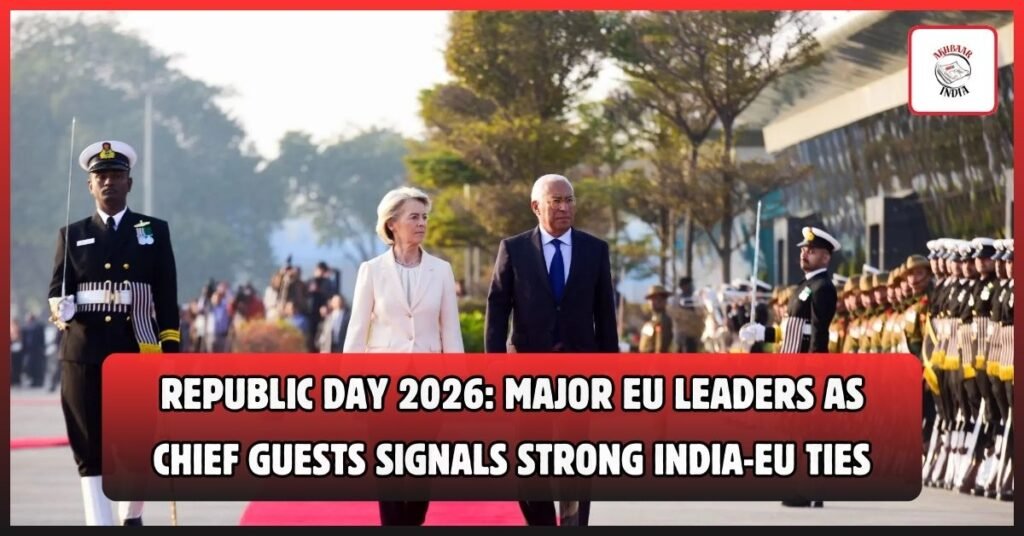
At first glance, the EU–India FTA deal and India’s Republic Day chief guests may seem like completely different topics. Many readers may wonder why a discussion on Europe–India trade is appearing alongside Republic Day celebrations.This curiosity is natural. But before you scroll away, take a moment. There is a strong and important connection between the two. European leaders did not visit India only to attend the Republic Day ceremony. Their presence marked a much larger diplomatic and economic development that could shape India’s future.
Regular readers of our Republic Day coverage may already be aware of the background. However, this article explains in simple terms who the European chief guests were, why they visited India, and how their visit is directly linked to one of the most significant trade negotiations India has undertaken.
In just a few minutes, you will gain clear and accurate insights that you can easily share with family, friends, or children to enhance general knowledge and understanding of India’s growing global influence.
Republic Day 2026 Chief Guests: Who Were They?
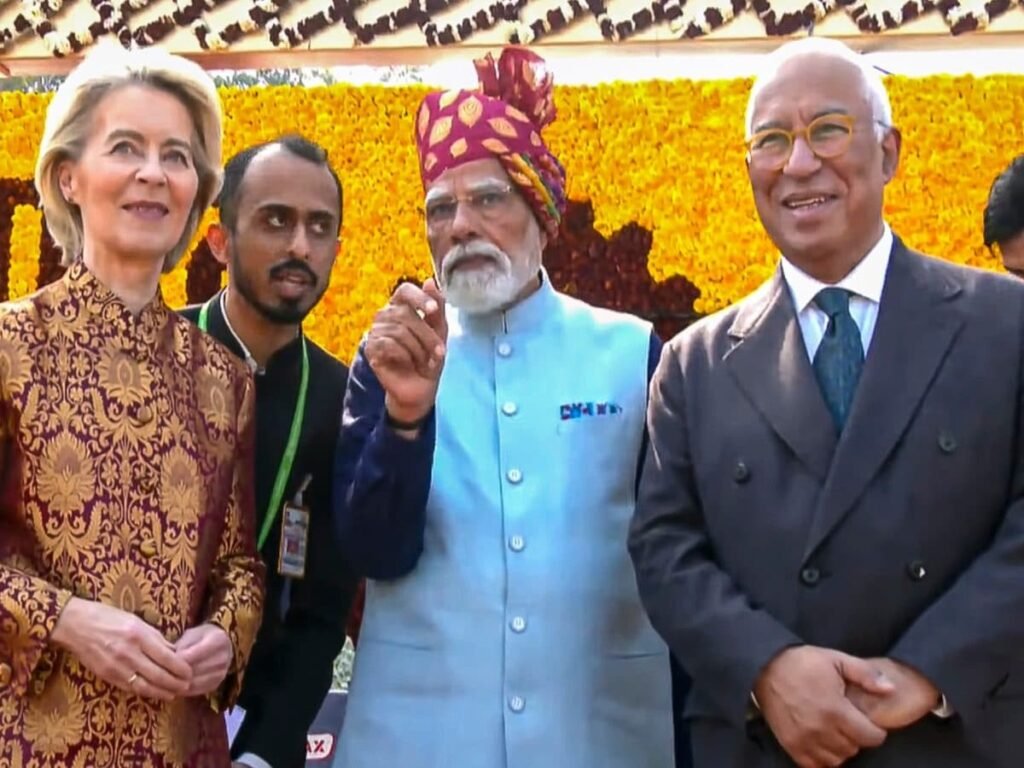
In 2026, the chief guest of India’s Republic Day was the Honourable European Commission President, Ursula von der Leyen.The respected and honourable chief guest arrived in India on 24 January 2026.
Union Minister Jitin Prasada welcomed Ursula von der Leyen in New Delhi on 26 January 2026. During her four-day visit to India, she, along with European Council President Antonio Costa, met the Honourable Prime Minister of India, Narendra Modi, after the Republic Day celebrations.
Why Did European Leaders Visit India?
The European leaders represented the 16th EU–India Summit, where they were also accompanied by President Droupadi Murmu and Vice President C. P. Radhakrishnan.Their main objective was to mark a major strategic shift aimed at strengthening India–EU trade, defence, and technology ties.The key focus of the meeting was finalising the EU-India FTA (Free Trade Agreement )deal and enhancing security cooperation.
EU-India FTA: An Important Turning Point in India’s Trade Strategy
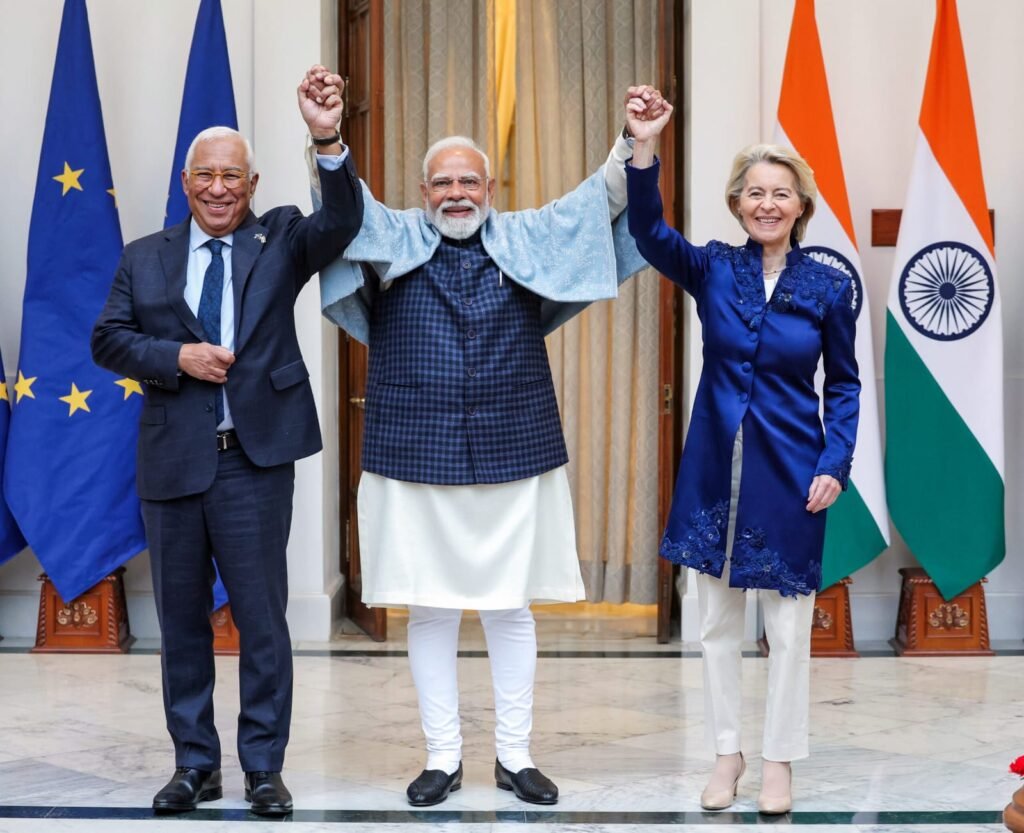
This deal marks an important turning point in India’s global trade strategy.The FTA, signed with European Commission President Ursula von der Leyen and European Council President Antonio Costa at the 16th EU–India Summit, makes the European Union India’s 22nd Free Trade Agreement partner.
The agreement covers:
This is why the EU-India FTA deal is often called the “Mother of All Deals.”
Which Sectors Will Benefit the Most?
Some of the most profitable sectors under the EU–India FTA include:
Beyond these, several other sectors will benefit:
CBAM and Green Trade Framework Explained
The CBAM (Carbon Border Adjustment Mechanism) will also be applied.It will support exports from the steel and aluminium industries.A new framework for green and sustainable trade has also been introduced, aligning the deal with long-term climate and sustainability goals.
What Is the Advantage of the EU–India Deal for the Common Man?
Indian farmers — the true food providers — stand to benefit. Without food, the world cannot survive.
This deal supports:
Cybersecurity and data-governed digital flows are also important components of this agreement.
How Will This Deal Impact Prices and Employment?
Tariff reductions on:
will reduce the extra burden on buyers.
Overall, this deal is heavily focused on the future economy. It is a major step toward protecting domestic industries that were ignored in past years, increasing employment in heavy industries, tackling unemployment, and reducing poverty — one of the biggest challenges facing the Indian economy.
Both Indian and European companies can reshape global trade flows and increase the movement of skilled talent.
A Geopolitical Shift Towards Viksit Bharat 2047
This agreement also represents a geopolitical realignment.The European Union secures a long-term and reliable partner in Asia.It can clearly be seen as a strong step toward India’s vision of “Viksit Bharat 2047.”
The EU–India FTA deal reflects India’s smart and timely economic strategy during a period of global uncertainty. The visit of European leaders on Republic Day 2026 was not just symbolic but marked a deeper shift in India’s trade, diplomatic, and geopolitical approach. By strengthening ties with the European Union, India has opened new opportunities for farmers, industries, startups, and skilled professionals while protecting domestic interests. With its focus on sustainable growth, employment generation, and global competitiveness, the EU–India FTA deal stands as a significant step toward India’s long-term vision of Viksit Bharat 2047.