E20 Petrol Rule From April 1, 2026: Big Fuel Shift in India — Will Your Vehicle Be Ready?
India is witnessing another major policy shift after several March and April 2026 updates. This time, the focus is on the E20 Petrol Rule, a move that could directly impact crores of vehicle owners across the country.
In the past few days, we have covered multiple updates implemented from March 1 and April 1, 2026. Today, we are discussing the E20 Petrol Rule and what it really means for consumers, farmers, and the automobile sector.
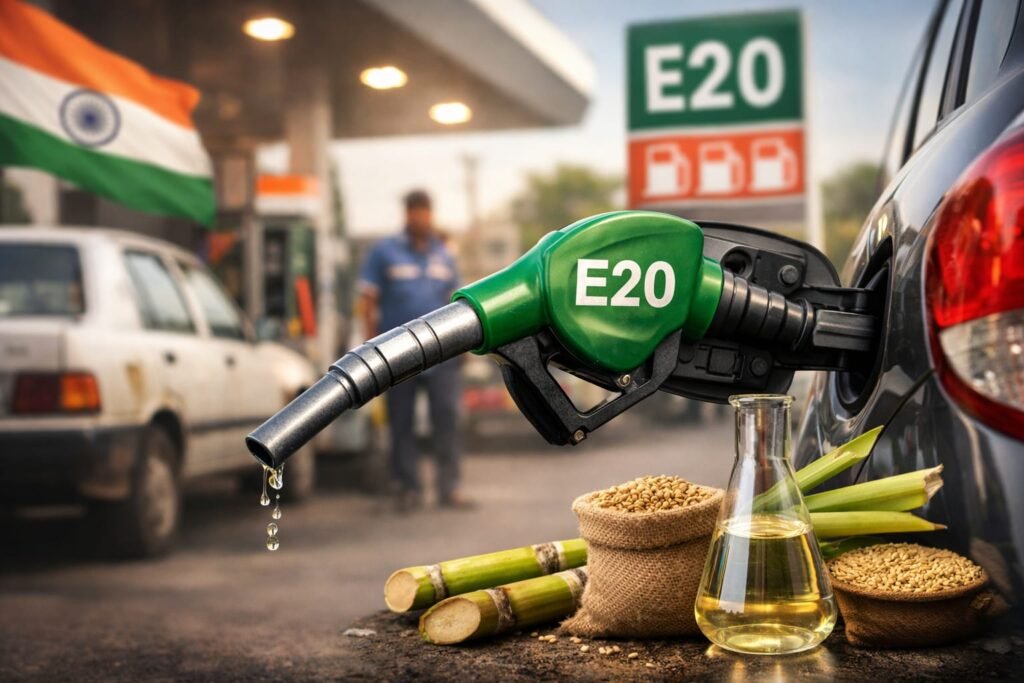
What Is the E20 Petrol Rule?
Ethanol-blended petrol mixes fossil fuel with bio-ethanol (from sugarcane and grains) to improve octane rating and reduce emissions.
Under the new E20 Petrol Rule, India is aggressively moving from E10 (10% ethanol) to E20 (20% ethanol). Earlier, petrol consisted of 90% petrol and 10% ethanol. Now, it is being upgraded to 80% petrol and 20% ethanol by 2026.
Although E20 petrol has been introduced in many parts of the country since 2023, it was optional. However, from April 1, 2026, the central government has mandated the sale of E20 petrol across the country.
The Petroleum Ministry of India has issued a notification requiring oil companies to supply petrol blended with 20% ethanol in all states and union territories.
Environmental and Economical Benefits of E20 Petrol Rule
The E20 Petrol Rule is being seen as a major environmental and economic reform.
This move is expected to benefit farmers significantly while also supporting India’s energy security goals.
Performance Impact: What Changes for Your Vehicle?
Ethanol has a higher octane number, providing better anti-knocking properties and improved acceleration.
RON (Research Octane Number) is a measure of fuel resistance to engine knocking (pre-ignition). Knocking happens when fuel burns unevenly inside the engine, causing a pinging sound, loss of power, and possible engine damage over time.
In simple terms, octane is like a fuel’s “self-control under pressure.” Higher RON means the fuel stays stable under high compression.
However, under the E20 Petrol Rule, some performance-related changes may be noticed:
Mileage reduction may be more visible in older vehicles.
Vehicle Compatibility: Who Should Be Careful?
Vehicles sold in India since 2023 are generally compatible with E20 fuel. Automobile manufacturers have already started producing E20-compatible engines.
However, older vehicles (especially those manufactured before 2023) may experience minor issues with rubber and plastic components. In some cases, rubber parts and gaskets may require replacement earlier than when non-blended fuel was used.
The good news is that such replacements are inexpensive and can be managed during routine servicing.
The E20 Petrol Rule may also raise concerns regarding vehicle insurance validity, though the government has assured minimal consumer impact during this transition.
Will There Be Any Exceptions?
The central government may allow exceptions in special situations for specific regions and for a limited time. However, the overall direction is clear — E20 will become the standard fuel across India from April 1, 2026.
Also Read: Bank Account Freeze in 2026: New Court & RBI Rules Every Indian Must Know Before It’s Too Late
What This Means for Consumers
Maybe this move of the government is good for the agricultural sector and farmers, but consumers with vehicles manufactured before 2023 may have to make some technical adjustments to avoid future problems.
India remains committed to cleaner and more sustainable fuel options. The E20 Petrol Rule marks a significant step toward reducing pollution and cutting oil imports.
With less than a month to go before full implementation, vehicle owners should check compatibility and consult service centers if needed.
Tell us in the comments — Is your vehicle E20 ready, or are you worried about mileage and maintenance costs under the E20 Petrol Rule?
Disclaimer: This article is published for informational purposes only. Readers are advised to verify details from official sources before making any decisions. The website is not responsible for any loss or damage arising from the use of this information.