AI Impact on Jobs After PM Modi’s Global AI Summit 2026: Stock Market Shock, 300 Million Jobs at Risk — Boom or Big Disruption?
Last week, the global spotlight was on New Delhi as leaders and ministers from across the world gathered for the AI Summit 2026, hosted by Honourable Prime Minister Narendra Modi. The high-profile event positioned India at the center of the artificial intelligence revolution. But almost immediately, markets reacted. The stock market witnessed volatility and decline, raising one big question — what is the real AI Impact on Jobs and the global economy?
In today’s blog, we discuss the gain and pain of AI for India and the world.
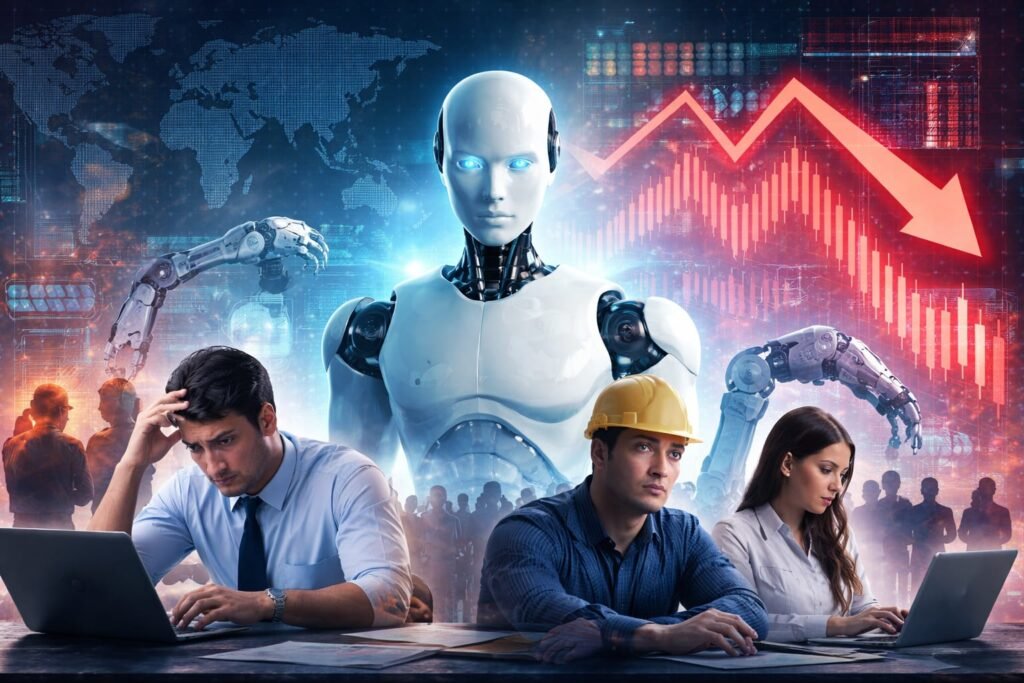
AI Impact on Jobs: 300 Million Roles at Risk?
AI is transforming the workforce by automating routine tasks and augmenting, rather than entirely replacing, many jobs. Estimates suggest it could impact 300 million jobs globally. While industries like customer service, manufacturing, and marketing face displacement risks, AI also creates new roles in data science and AI development.
Automation and displacement are heavily impacting white-collar and routine jobs. At the same time, AI could automate roughly 85 million jobs but create 97 million new roles, emphasizing the urgent need for up skilling.
The AI Impact on Jobs clearly shows both disruption and opportunity.
IT Industry Pivot: From Basic Services to AI Governance
Companies are no longer just offering basic IT services. The focus has shifted toward data quality, security, and governance to build, maintain, and secure AI models.
AI is profoundly transforming the IT industry by automating routine tasks, enhancing cybersecurity through real-time threat detection, and optimizing data management. AI-powered coding agents now debug and generate code, streamlining the software development lifecycle. Machine learning models detect anomalies faster than human analysts.
IT professionals are moving away from routine maintenance toward AI-driven innovation and complex problem-solving. While some traditional IT roles may slow down, the industry is rapidly adapting to leverage AI for competitive advantage.
Economic Shock or Economic Boom?
The AI sector is experiencing high growth. AI is projected to contribute $15.7 trillion to the global economy by 2030 and could add $14 trillion by 2035 through productivity gains.
In India, the AI market is projected to cross $17 billion by 2027. However, the AI Impact on Jobs in India is significant. Around 40–45 million workers may need re skilling by 2025. While AI threatens to displace nearly 2 million tech jobs, it is expected to create 4 million new roles.
This shift may increase wage polarisation and income inequality if re skilling efforts are not accelerated.
Sector-Wise Impact: Not Just Tech
The AI story is not limited to technology companies. It could become a broad investment wave impacting power, infrastructure, engineering, finance, and transportation.
After two years of sluggishness, the commercial vehicle sector is showing improvement due to increased private investment and construction activity. Demand for commercial vehicles is picking up, benefiting automakers and finance companies.
Interestingly, experts see opportunity in power equipment, generators, and HVAC systems rather than semiconductors. With data center construction accelerating, demand in electrical equipment and engineering supply chains could rise. The AI era may reflect not just a technology cycle but an industrial investment cycle.
Employment Effects: Displacement vs Creation
While AI may displace 60 million manufacturing workers by 2030 and impact routine, low-skill jobs, it is simultaneously creating opportunities in AI consulting, machine learning, prompt engineering, and data analytics.
AI acts as a force multiplier. It boosts productivity by up to 15% in sectors like finance and agriculture. In IT, AI saves hours per week by automating customer support and data entry.
The AI Impact on Jobs is not just about job loss — it is about job transformation and human-AI collaboration.
Governments and educational institutions must focus on a “re skilling revolution” to prepare the workforce for an AI-driven economy.
Societal Risks and Ethical Concerns
A major concern is algorithmic bias and discrimination. Around 25% of work tasks in the U.S. and Europe could be automated. Ethical concerns, wage inequality, and the loss of human touch and creativity are real risks.
At the same time, AI improves healthcare, personalised services, predictive analytics, and operational efficiency across industries.
Boon or Threat?
The craze for AI is increasing worldwide. Big companies are using AI to reduce costs. While unemployment risks exist, new generations may benefit by learning new techniques and AI skills.
AI shapes job opportunities, challenges, and the future of work. The AI Impact on Jobs shows both uncertainty and massive potential. It may reduce human touch in some areas, but it also unlocks innovation and productivity.
AI may be beneficial as well as a loss for humanity — the outcome depends on how quickly we adapt, re skill, and govern this transformation.
What do you think — will AI Impact on Jobs create more opportunities or more unemployment in the coming years? Share your opinion in the comments