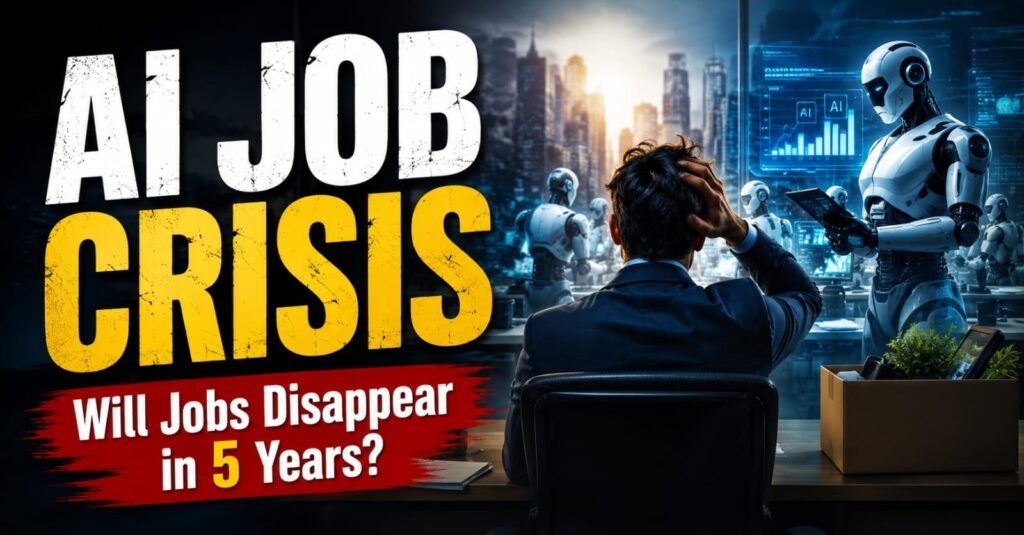
AI Job Crisis: Will 7 Powerful Yet Alarming Predictions Make Traditional Jobs Obsolete Within 5 Years?
Today’s biggest concern for millions of people is no longer just inflation or economic uncertainty—it is the growing AI job crisis. As artificial intelligence and humanoid robots become part of everyday life, many workers fear that career opportunities could shrink faster than expected.
Some people have already lost their jobs. Others are protesting after large numbers of workers were replaced at the same time. For many families, a job is not just employment—it is survival. Parents support children, children support aging parents, and households depend on regular income to meet daily needs.
In this blog, we explore the growing AI job crisis, Elon Musk’s bold predictions about the future of work, the possible benefits of an AI-powered economy, and the challenges society may face during this historic transition.
Why the AI Job Crisis Is Creating Anxiety Worldwide
The rapid rise of AI and robotics is changing how businesses operate. Companies are increasingly using automation to improve efficiency and reduce operational costs.
When a person suddenly loses a job without having another source of income, the impact can be severe. Bills continue, education expenses remain, and daily living costs do not stop. This is one reason the AI job crisis has become a topic of discussion across the world.
At the same time, companies are also facing challenges. While AI systems can perform many tasks quickly, they do not possess human emotions, judgment, or complete legal understanding. Some businesses are discovering that replacing people entirely is not always as simple as expected.
Elon Musk’s Prediction: Will the AI Job Crisis Peak Within 5 Years?
Elon Musk has predicted that rapid advancements in artificial intelligence and humanoid robotics could fundamentally disrupt traditional jobs within the next five years.
He believes many forms of work may become economically unnecessary as machines perform both physical and cognitive tasks more efficiently than humans. In Musk’s vision, the AI job crisis could eventually lead to a completely different economic system.
Instead of relying on traditional employment, society may move toward a model where technology generates abundant goods and services at extremely low cost.
Universal High Income: Musk’s Alternative to UBI
Rather than a standard Universal Basic Income (UBI), Musk has discussed the concept of Universal High Income (UHI).
Under this idea, AI and robotics would create such massive productivity that everyone could enjoy access to goods and services regardless of whether they hold a traditional job.
Supporters believe this could reduce poverty and provide financial security even during an AI job crisis. People could focus on personal interests, creativity, learning, sports, gardening, or other activities instead of working purely for survival.
How the AI Job Crisis Could Change Wealth Creation
Musk has suggested that coding and many cognitive tasks may eventually be handled by advanced AI systems.
If that happens, wealth creation may increasingly favor those who own technology assets, automated businesses, or AI-driven platforms rather than people relying solely on salaries and hourly wages.
This possibility is one reason the AI job crisis is attracting attention from workers, investors, and policymakers alike.
Potential Advantages of an AI-Powered Future
End of Scarcity
Supporters envision a post-scarcity economy where goods and services become available in nearly unlimited quantities at minimal cost.
More Freedom and Flexibility
People may no longer need to live near expensive job centers. They could choose where they want to live and spend more time with family, hobbies, and personal development.
Explosive Productivity Growth
Advanced AI could dramatically increase global productivity, making products, services, and knowledge more accessible than ever before.
Major Concerns About the AI Job Crisis
Difficult Transition Period
The biggest challenge may be the transition itself. During the next few years, technology could replace jobs faster than new opportunities are created.
Workers who depend entirely on traditional wages may face financial pressure if they are not prepared for changing employment trends.
Loss of Purpose and Identity
For generations, work has provided structure, achievement, and social connection. If machines perform most tasks better than humans, society may need to redefine purpose and personal fulfillment.
Implementation Challenges
Many critics remain skeptical about whether a smooth transition to a post-work economy is realistic. Questions remain about funding, governance, wealth distribution, and long-term social stability.
The AI job crisis is no longer a distant possibility—it is becoming a reality that people, businesses, and governments are beginning to confront. Whether Elon Musk’s vision becomes fully true or not, one thing is clear: the relationship between humans, work, and technology is changing rapidly.
The coming years may bring extraordinary opportunities as well as serious challenges. Preparing early, learning new skills, and staying informed could be the key to thriving in an AI-driven world.
FAQs
What do you think—will AI create more opportunities than it destroys? Keep visiting our site for more future-focused updates, technology insights, and career trends.
Disclaimer: This article is published for informational purposes only. Market Prices are subject to market risks and real-time fluctuations. Readers are advised to verify prices from official sources before making any financial decisions. The website is not responsible for any loss or damage arising from the use of this information.