Will the Fehmarnbelt Tunnel Transform European Travel Forever? 7 Powerful Facts Behind the Baltic Sea Mega Project
In this blog, we explore the remarkable progress of the Fehmarnbelt Tunnel, one of Europe’s most ambitious infrastructure projects. Stretching beneath the Baltic Sea and connecting Germany with Denmark, this engineering marvel is expected to reshape travel, trade, and connectivity across Northern Europe for decades to come.
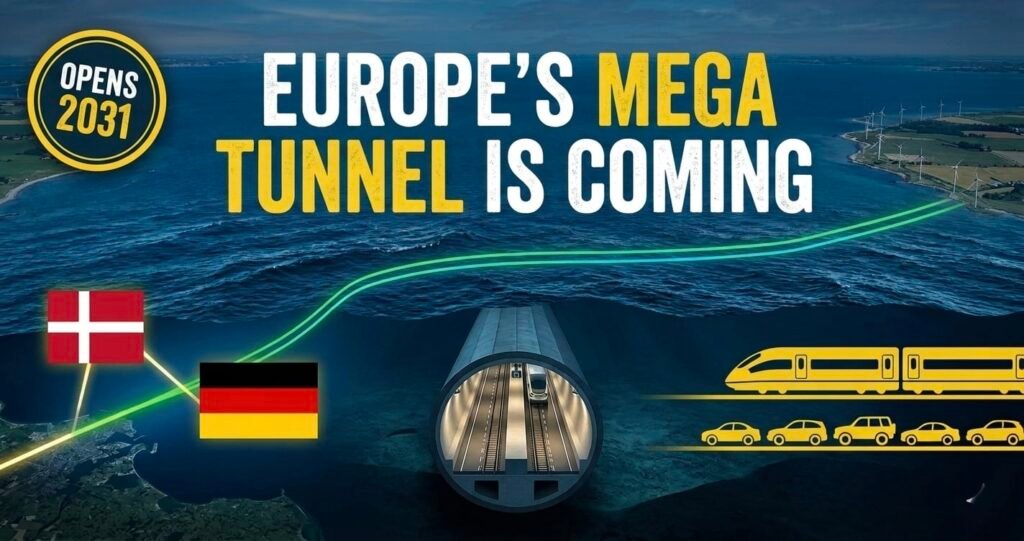
What Is the Fehmarnbelt Tunnel?
The Fehmarnbelt Tunnel is an 18-kilometer immersed tunnel being built beneath the Baltic Sea between Puttgarden in Germany and Rødbyhavn in Denmark. Once completed, it will become the world’s longest combined road and rail immersed tunnel, creating a direct fixed link between Scandinavia and Central Europe.
Designed to carry both road and rail traffic, the tunnel will feature a four-lane motorway alongside a two-track electrified railway, significantly improving transportation efficiency between the two countries.
A Journey That Will Save Hours
One of the biggest advantages of the Fehmarnbelt Tunnel is the dramatic reduction in travel time.
The current train journey between Copenhagen and Hamburg takes around 4.5 hours. After the tunnel opens, that trip is expected to be reduced to approximately 2.5 hours. Drivers will also benefit, with the crossing itself taking only about 10 minutes and cutting roughly an hour from existing travel routes.
This improvement is expected to make business travel, tourism, and freight transportation much faster and more convenient.
Built Using a Unique Engineering Method
Unlike many famous underwater tunnels that are drilled through rock, the Fehmarnbelt Tunnel is being constructed using an immersed tunnel technique.
Engineers are creating a trench on the seabed where giant reinforced concrete sections will be placed. Each tunnel element measures approximately 217 meters in length and weighs around 73,000 tons.
These enormous sections are manufactured at a specialized production facility in Rødby, Denmark. Once completed, they are floated into position, carefully lowered into the trench, and connected with remarkable precision.
A total of 89 concrete elements will form the finished tunnel structure.
A Multi-Billion-Euro Investment
The project represents one of Europe’s largest infrastructure investments.
The overall budget is estimated at approximately €7 billion to €8.7 billion, with Denmark financing and operating the project. The investment reflects the long-term strategic importance of creating a stronger transport corridor between Northern and Central Europe.
Why the Opening Date Was Delayed
The tunnel was initially expected to open earlier, but several factors pushed the timeline back.
Extended approval procedures, environmental requirements in German waters, and delays related to railway infrastructure upgrades on the German side resulted in revised schedules.
Road traffic is now expected to begin using the tunnel in 2031, while the railway connection is projected to follow in 2032.
Construction Is Moving Forward
Construction officially started in 2020 on the Danish side and in 2021 on the German side.
Since then, major milestones have been achieved. The tunnel element factory in Rødby has been producing the massive concrete sections, while dredging operations in the Baltic Sea have progressed steadily.
The immersion of completed tunnel elements continues, bringing the project closer to reality with each phase of construction.
The Vision Began Years Ago
Although construction is now highly visible, the idea has been in development for many years.
The breakthrough came in 2008 when Germany and Denmark signed a formal State Treaty agreeing to establish a fixed link across the Fehmarn Belt.
That agreement transformed a long-discussed vision into a concrete international infrastructure project.
Key Organizations Behind the Project
Several major organizations have played critical roles in shaping the Fehmarnbelt Tunnel.
Femern A/S, a state-owned Danish company and subsidiary of Sund & Bælt Holding A/S, is responsible for planning, designing, and constructing the tunnel.
The European Union has strongly supported the project as part of its Trans-European Transport Network (TEN-T), which aims to improve transportation links across Europe.
Technical concepts and engineering studies were developed by the RAT joint venture, consisting of Ramboll, Arup, and TEC, working closely with project stakeholders.
Why the Fehmarnbelt Tunnel Matters
Beyond reducing travel times, the Fehmarnbelt Tunnel is expected to strengthen economic connections, improve freight movement, boost tourism, and create a faster transportation corridor linking Scandinavia with the heart of Europe.
For many travelers, it could become one of the most important transport links on the continent once operational.
FAQ
As Europe moves closer to completing this historic connection beneath the Baltic Sea, stay connected with us for more infrastructure breakthroughs, travel innovations, and future-shaping projects from around the world.
Disclaimer: This article is published for informational purposes only. Readers are advised to verify details from official sources before making any decisions. The website is not responsible for any loss or damage arising from the use of this information.