The AI Infrastructure Bubble Looked Unstoppable—So Why Are Companies Suddenly Worried?
For a while, AI seemed like the perfect solution for every business problem. Now, as companies spend billions to keep these systems running, many are discovering that the reality is far more complex. The growing debate around the AI Infrastructure Bubble reveals why some expectations may have been too optimistic.
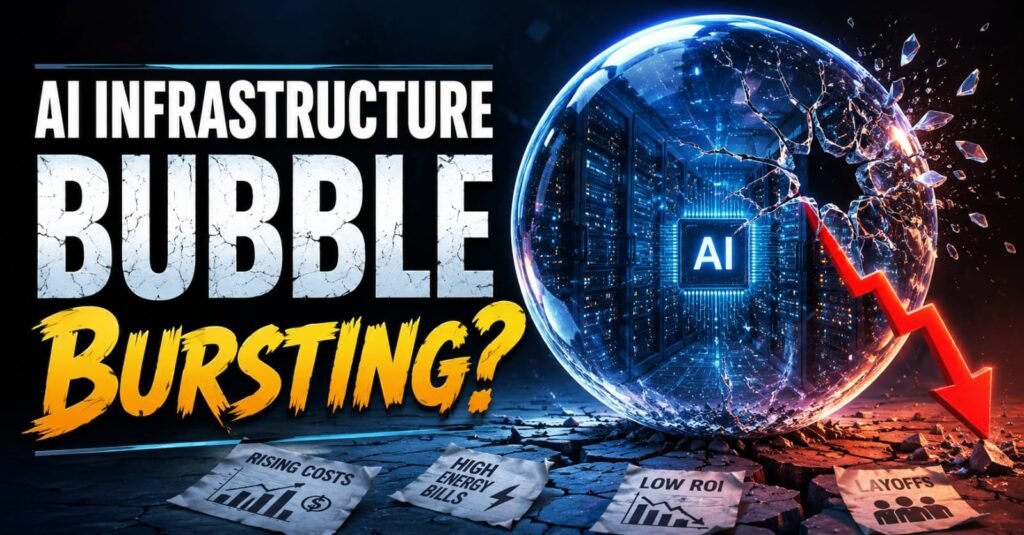
AI Infrastructure Bubble: Why Companies Are Rethinking Their Biggest Investment
For the last two years, Artificial Intelligence has been one of the biggest trends in the corporate world. Many companies believed AI would dramatically increase productivity and reduce expenses. As a result, thousands of employees lost their jobs because businesses assumed AI could replace a large portion of human work. However, reality is now showing a different picture.
The discussion around the AI Infrastructure Bubble is growing as companies discover that AI alone is not always as productive as expected. While AI remains a powerful technology, businesses are now realizing that human expertise is still necessary for long-term success.
What Happened After Companies Replaced Employees With AI?
The first question that comes to mind is: what happened exactly?
Many companies made thousands of employed people unemployed due to their insufficient understanding of how AI works in real business environments.
AI systems require coding, decoding, monitoring, maintenance, and technical supervision. Many office workers were not aware of these requirements. In several cases, companies reduced their workforce expecting AI to handle most tasks automatically.
As a result, many people suddenly found themselves unemployed. They still had personal responsibilities, household expenses, and loans to manage. While businesses initially celebrated lower salary expenses, the long-term reality turned out to be more complicated.
The Hidden Cost Behind the AI Infrastructure Bubble
Companies believed AI would reduce operational costs. Instead, many discovered that operating AI at scale requires enormous resources.
AI systems need:
In some cases, the cost of maintaining AI infrastructure became much higher than expected. Businesses that planned major savings began facing rising operational expenses.
This growing concern is one of the reasons experts and investors have started discussing the AI Infrastructure Bubble more seriously.
Why Productivity Gains Are Harder to Measure
Another challenge is measuring the actual return on investment.
Many organizations adopted AI tools expecting immediate productivity improvements. However, after spending heavily on AI systems, some companies struggled to identify measurable benefits.
Large amounts of computing power were consumed processing prompts and generating outputs, but businesses often found it difficult to connect that spending directly to faster product development or significantly improved performance.
This does not mean AI is failing. It simply means that companies are learning where AI creates value and where human skills remain essential.
Google, Microsoft and Other Tech Giants Face New Challenges
Technology giants such as Google and Microsoft continue investing billions in AI infrastructure.
However, they are also facing practical challenges:
Massive Operational Costs
Running AI models requires huge amounts of computing power. Processing tokens and prompts at scale can become extremely expensive.
Unclear ROI
Companies are still working to determine whether AI investments are producing enough real-world productivity gains to justify the costs.
Environmental Pressure
AI data centers consume significant energy and water resources. This has raised concerns about carbon emissions and sustainability goals, creating pressure on companies trying to meet environmental commitments.
Is the AI Infrastructure Bubble a Temporary Correction?
It is important to understand that this situation does not mean AI is finished.
Instead, it appears to be a correction period. Businesses are learning from early mistakes and discovering that successful AI adoption requires a balance between technology and human expertise.
Many organizations are now focusing on combining AI tools with skilled employees rather than treating AI as a complete replacement for people.
The AI Infrastructure Bubble may become a challenge for the industry, but it could also help companies build more sustainable and realistic AI strategies in the future.
Artificial Intelligence remains one of the most powerful technologies of our time. However, the recent concerns surrounding the AI Infrastructure Bubble show that technology alone cannot solve every business problem.
The next phase of AI may not be about replacing humans. It may be about helping humans work better, faster, and smarter.
FAQs
What happens next will determine whether today’s AI spending becomes tomorrow’s success story or a costly lesson. Keep visiting our site for more simple and practical insights on the trends that are shaping the future of technology.
Disclaimer: This article is published for informational purposes only. Readers are advised to verify details from official sources before making any decisions. The website is not responsible for any loss or damage arising from the use of this information.